

The history of CBD for dogs reaches back thousands of years, long before modern science identified cannabidiol as a distinct compound. From ancient civilizations that treated working animals with cannabis preparations to today’s peer-reviewed clinical trials at major veterinary universities, cannabinoids have always played a role in animal care. This article traces that full arc, covering the discovery of the endocannabinoid system in dogs, the landmark research milestones that shaped veterinary cannabinoid medicine, and what the science tells us about CBD for dogs today.
Table of Contents
- What Is CBD? The Basics of CBD for Dogs
- The History of CBD for Dogs: Ancient Roots (2700 BC – 1800s)
- The Scientific Discovery of CBD and the Endocannabinoid System
- The Modern CBD Era: Legalization and Veterinary Research
- CBD in Veterinary Medicine: Species by Species
- How Peak Therapeutics Is Different
- Dr. Gaynor’s Published Works on Cannabinoid Medicine
- Frequently Asked Questions About CBD for Dogs
- The History of CBD for Dogs: What It Means for Your Pet Today
- References
- About Dr. James S. Gaynor
Key Takeaways: The History of CBD for Dogs
- Cannabis has been used in animal care for over 5,000 years across virtually every major agricultural civilization.
- CBD (cannabidiol) is a non-intoxicating compound from hemp that works through the endocannabinoid system, a biological network present in all mammals, including dogs.
- CBD was first isolated in 1940 by Roger Adams. The endocannabinoid system was discovered between 1988 and 1993.
- The 2018 Farm Bill legalized hemp-derived CBD nationwide, enabling veterinary CBD products like those from Peak Therapeutics.
- Peer-reviewed research from Cornell, Colorado State, and Peak Therapeutics supports CBD’s beneficial role in canine comfort and mobility.
- Peak Therapeutics was founded by Dr. James Gaynor, a board-certified veterinary anesthesiologist and co-editor of the definitive academic textbook on veterinary cannabinoid medicine.
What Is CBD? The Basics of CBD for Dogs
CBD (cannabidiol) is one of over 100 naturally occurring compounds called cannabinoids found in the Cannabis sativa plant. Cannabis sativa stands as one of the most significant medicinal plants in human history, with ethnopharmacological use spanning thousands of years across virtually every major civilization. Unlike THC (tetrahydrocannabinol), CBD is entirely non-intoxicating and is safe for animals when properly formulated and dosed.
For pets, CBD is derived from industrial hemp, a cannabis variety legally required to contain less than 0.3% THC. CBD for dogs works by interacting with the endocannabinoid system (ECS), a biological regulatory network present in all mammals, including dogs, cats, and horses. Specifically, the ECS plays a central role in governing comfort, mood, immune response, appetite, and sleep.
Furthermore, a 2024 comparative review confirmed the ECS is conserved across the main species of veterinary interest, with species-specific differences in receptor distribution and cannabinoid metabolism. In fact, understanding the endocannabinoid system in dogs is the key to understanding why cannabinoids have such broad potential in veterinary wellness.
| CBD Basics | At a Glance |
|---|---|
| Full name | Cannabidiol (CBD) |
| Source | Cannabis sativa, primarily industrial hemp |
| Intoxicating? | No, zero intoxication |
| THC content | Less than 0.3% by weight (Peak Therapeutics) |
| Extraction | CO₂ extraction, the cleanest solvent-free process that preserves the full cannabinoid and terpene profile |
| Forms | Tinctures, edibles, specialty blends (CBD+CBG Pink Label, CBD+CBN Purple Label) |
The History of CBD for Dogs: Ancient Roots (2700 BC – 1800s)
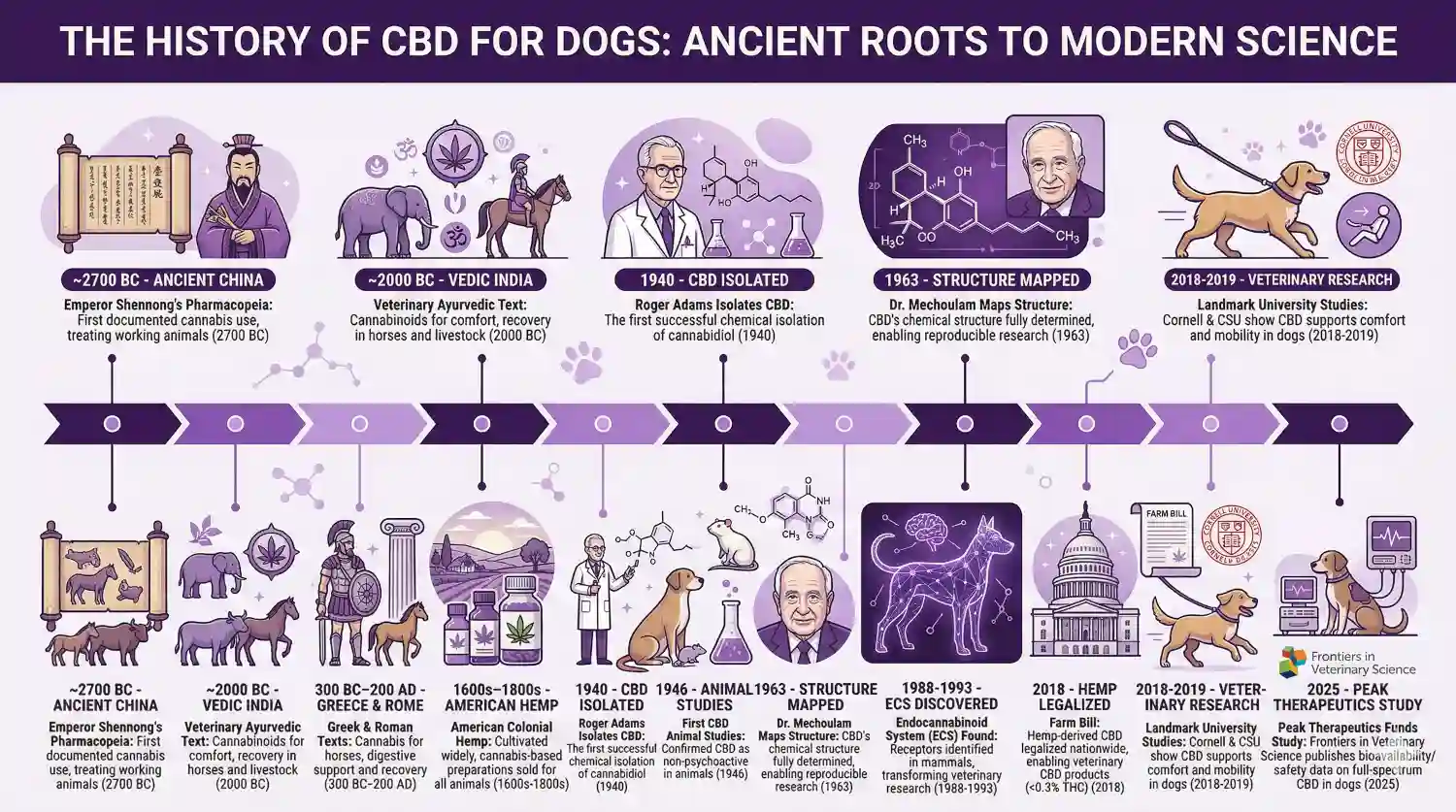 The Cannabis sativa plant has been cultivated by human civilizations for at least 5,000 years, and animals have been part of that story from the very beginning. Archaeological and historical evidence confirms that cannabis was attested to around 12,000 years ago near the Altai Mountains in Central Asia, and its seeds have accompanied the migration of nomadic peoples ever since.
The medicinal use of cannabis was documented before the Common Era in China, Egypt, and Greece. In virtually every agricultural society that grew cannabis, working animals were treated alongside humans using the same plant preparations.
~2700 BC: Emperor Shennong’s Pharmacopeia, China
The ancient Chinese text Shennong Bencao Jing documents cannabis for rheumatism and pain. Working animals (horses, oxen, and camels) were treated alongside humans with cannabis preparations.
~2000 BC: Vedic India and Cannabis in Animal Care
Ancient Ayurvedic veterinary medicine described cannabis preparations for livestock, horses, and elephants to support comfort, calm, and recovery from injury. Additionally, these are among the earliest written records of intentional cannabinoid use in animals.
~300 BC–200 AD: Greece and Rome
Greek physician Dioscorides recorded cannabis in De Materia Medica. Similarly, Roman texts describe hemp preparations given to horses for digestive discomfort and support during recovery. These represent some of the oldest documented cannabinoid use in animals in the Western world.
1600s–1800s: Hemp in America, from Cash Crop to Medicine
Hemp was among the most widely cultivated crops in the American colonies, required by law in some regions. By the late 1800s, cannabis-based preparations for both humans and animals were sold openly in pharmacies across America and Europe.
“In every agricultural civilization that cultivated cannabis, working animals were treated alongside humans. The plant’s relationship with animal health is older than recorded medicine.” — Peak Therapeutics
The Scientific Discovery of CBD and the Endocannabinoid System
The transition from folk medicine to pharmaceutical science required isolating and characterizing individual cannabinoids, a process that unfolded across landmark discoveries spanning decades.
1940: Roger Adams Isolates CBD for the First Time
American chemist Roger Adams at the University of Illinois became the first scientist to successfully isolate cannabidiol (CBD) from cannabis extract, establishing the foundation of modern cannabinoid science. Adams’ pioneering isolation of CBD from Minnesota wild hemp is documented in detail in a 2020 PMC article on the botanical sources of early cannabinoid discovery, and in Crocq’s history of cannabis and the endocannabinoid system.
1946: First Controlled CBD Animal Studies
Pharmacologist Dr. Walter Loewe administered cannabinoid compounds to laboratory animals in the first controlled study of its kind. His pivotal finding: while THC produced clear neurological effects in animals, CBD did not. Moreover, this was the first scientific evidence that CBD is non-psychoactive in animals, a finding that remains foundational to veterinary cannabinoid medicine and CBD for dogs today.
Loewe’s landmark animal studies are documented in Zuardi’s history of cannabis as a medicine.
1963: Dr. Raphael Mechoulam Maps CBD’s Structure
Israeli chemist Dr. Raphael Mechoulam, widely known as the Father of Cannabis Research, fully determined the chemical structure of CBD. Additionally, he identified THC the following year. As a result, this work made precise, reproducible pharmaceutical research into cannabinoids possible for the first time.
Mechoulam’s breakthrough and its transformative impact on cannabinoid science are reviewed in Pisanti and Bifulco’s plurimillennial history of medical cannabis and in Bonini et al.’s ethnopharmacological review.
1988–1993: The Endocannabinoid System Is Discovered
Researchers identified CB1 receptors (1988) and CB2 receptors (1993) in mammalian tissue, revealing for the first time that dogs, cats, and all mammals have a dedicated biological system designed to interact with cannabinoids. What’s more, this discovery of the endocannabinoid system transformed CBD from a chemical curiosity into a subject of serious pharmaceutical and veterinary research.
As a result, the discovery directly enabled today’s CBD for dogs products. In particular, this pivotal work is documented in Crocq’s history of cannabis and the endocannabinoid system, which traces the scientific journey from ancient medicinal use through 20th-century receptor identification.
The Modern CBD Era: Legalization and Veterinary Research
A series of legal reforms, landmark clinical approvals, and high-profile public stories transformed CBD from a fringe topic into a mainstream wellness category. What’s more, veterinary applications and CBD for dogs drove much of the public interest throughout this period.
2013: Charlotte Figi’s Story Goes Global
Charlotte Figi’s experience with a high-CBD cannabis extract, documented in CNN’s Weed documentary by Dr. Sanjay Gupta, sparked widespread public and scientific interest in CBD’s potential wellness applications for both people and animals. As a result, research funding and regulatory discussions accelerated. Watch: CNN’s Weed documentary by Dr. Sanjay Gupta.
2018: The Farm Bill Makes Hemp CBD Federally Legal
The Agriculture Improvement Act of 2018 removed hemp from the Controlled Substances List, legalizing hemp-derived CBD products with less than 0.3% THC nationwide. As a result, this legislation directly enabled veterinary CBD companies like Peak Therapeutics to develop and distribute CBD for dogs legally across the U.S. Full text: Agriculture Improvement Act of 2018 (H.R.2, 115th Congress).
2018: FDA Approves Epidiolex, the First CBD-Based Drug
The FDA’s approval of Epidiolex (a pharmaceutical-grade CBD product) for human epilepsy validated CBD’s clinical legitimacy at the highest regulatory level. Additionally, it established the evidence framework that continues to shape veterinary CBD research. Source: FDA press announcement.
2018–2019: Cornell and Colorado State Publish Landmark Veterinary CBD Research
Cornell University’s College of Veterinary Medicine published a landmark peer-reviewed study finding that CBD for dogs showed improved comfort scores and mobility with no adverse effects. Subsequently, Colorado State University’s veterinary college followed with additional clinical work, establishing the evidence base for canine CBD use. Overall, these studies remain foundational to understanding how CBD oil for dogs interacts with the endocannabinoid system in dogs.
2022: Systematic Review of Randomized Clinical Trials
A systematic review identified six randomized clinical trials of cannabis in animal disease. Across the osteoarthritis trials, CBD significantly reduced pain and increased activity in dogs.
2023: Review of CBD in Dogs
DiSalvo et al. further confirmed evidence for a beneficial role of CBD in canine comfort, mobility, and seizure management.
2024: Comparative Review Across Veterinary Species
A comparative review synthesized the full body of published evidence on cannabinoid receptor expression, CBD pharmacokinetics, and clinical efficacy. The review concluded that evidence supports a beneficial role for CBD across dogs, cats, and horses.
2025: Peak Therapeutics Funds Pharmacokinetics Study
A peer-reviewed pharmacokinetics study funded by Peak Therapeutics and published in Frontiers in Veterinary Science confirmed the bioavailability and safety profile of full-spectrum CBD in dogs, contributing directly to evidence-based dosing guidance for CBD oil for dogs.
CBD in Veterinary Medicine: Species by Species
The endocannabinoid system is present in all mammals, but how each species metabolizes and responds to cannabinoids varies in clinically important ways. For this reason, species-specific formulation is a cornerstone of responsible veterinary CBD practice, and CBD for dogs requires different concentrations and formulations than CBD for cats or horses.
| Species | CBD Considerations and Research |
|---|---|
| Dogs | The most studied species in veterinary CBD research. Cornell and Colorado State University have published peer-reviewed studies documenting improved comfort and mobility in dogs given CBD, with no significant adverse effects observed at therapeutic doses. Dogs have notably high CB1 receptor density in the cerebellum and brainstem, making the endocannabinoid system in dogs especially relevant to cannabinoid medicine. |
| Cats | Cats have a different metabolic profile from dogs. Specifically, they process certain compounds more slowly due to differences in liver enzyme activity. Therefore, species-specific formulations at appropriate concentrations are essential. Peak Therapeutics Yellow Label (50mg/ml) is designed specifically for cats and small dogs. |
| Horses | A growing area of interest in equine wellness and performance recovery. Peak Therapeutics offers equine formulations, continuing a tradition of cannabis-based equine care with roots stretching back to ancient Rome. |
| Small and Exotic Pets | Rabbits, ferrets, and birds also possess endocannabinoid systems. Micro-dosage formulations are emerging for these species, and veterinary guidance is especially important given their unique metabolic profiles. |
Safety Considerations for CBD for Dogs and Other Animals
Always use products specifically formulated for animals. For example, human CBD products may contain ingredients harmful to pets. THC is toxic to dogs and cats, so verify all products contain less than 0.3% THC and carry third-party lab testing.
Because cats metabolize compounds differently, species-appropriate products and doses are essential. Then, start with the lowest recommended dose and increase gradually over 2 to 4 weeks. Always consult a licensed veterinarian before beginning any CBD regimen, especially for pets on other medications.
How Peak Therapeutics Is Different
Most pet CBD brands are founded by entrepreneurs or marketers. Peak Therapeutics was founded by Dr. James Gaynor, a board-certified veterinary anesthesiologist, former university professor, co-editor of the academic textbook on veterinary cannabinoid medicine, and one of the most credentialed veterinary pain specialists in the country. As a result, every formulation decision for CBD for dogs reflects that clinical background.
| Difference | Details |
|---|---|
| Veterinarian-developed | Founded and formulated by Dr. James Gaynor, DACVAA, a board-certified veterinary anesthesiologist and pain management specialist. |
| Full-spectrum CO₂ extraction | Clean, solvent-free extraction preserves the complete cannabinoid and terpene profile for maximum entourage effect. |
| Third-party lab tested | Every batch independently tested for potency, purity, and THC compliance. Results published at peaktherapeutics.net. |
| Species-specific | Separate formulations and concentrations for cats/small dogs vs. medium/large dogs and horses. |
| Research-backed | Peak Therapeutics has funded peer-reviewed pharmacokinetic research published in Frontiers in Veterinary Science (2025). |
| Specialty blends | CBD+CBG (Pink Label: everyday calm) and CBD+CBN (Purple Label: nighttime support), each formulated for a specific clinical purpose. |
Peak Therapeutics Product Guide
| Product | Formulation and Purpose |
|---|---|
| Blue / Green Label | Healthy Pet CBD (100mg/ml). General everyday wellness for dogs and cats. |
| Yellow Label | Hemp Extract CBD (50mg/ml). Specifically formulated for cats and small dogs. |
| Pink Label | CBD Get Calm (CBD + CBG). Everyday calm and comfort support. |
| Purple Label | CBD Night (CBD + CBN). Targeted nighttime wellness and sleep support. |
| Edibles | CBD Treats (10mg each). Ideal for picky eaters with easy, consistent dosing. |
| EVA | Elk Velvet Antler. Joint health and muscle support through naturally occurring growth factors. |
Dr. Gaynor’s Published Works
Dr. Gaynor’s authority in veterinary cannabinoid medicine is not self-declared. It is documented in the peer-reviewed academic literature and in the textbooks used by veterinary professionals worldwide.
Cannabis Therapy in Veterinary Medicine (Springer, 2021)
Role: Co-editor and author
Editors: Stephen Cital, Katherine Kramer, Liz Hughston, James S. Gaynor
The gold-standard academic reference for veterinary cannabinoid medicine, covering pharmacology, clinical applications across species, and evidence-based dosing protocols for CBD for dogs, cats, and horses. Used by veterinary professionals and researchers worldwide. Available from Springer: Cannabis Therapy in Veterinary Medicine: A Complete Guide.
Handbook of Veterinary Pain Management, 3rd Edition (Mosby/Elsevier, 2015)
Role: Lead editor and author
The gold-standard clinical reference for veterinary pain management practitioners, covering multimodal analgesia, pharmacology, species-specific approaches, and integrative therapies including nutraceuticals. Available: Handbook of Veterinary Pain Management.
Frequently Asked Questions About CBD for Dogs and Pets
What is CBD and how does it work in dogs?
CBD (cannabidiol) is a non-psychoactive compound from the Cannabis sativa plant. CBD for dogs works by interacting with the endocannabinoid system (ECS), present in all mammals including dogs, cats, and horses, through CB1 and CB2 receptors to support overall balance and wellness without any intoxicating effects.
Is CBD safe for dogs and cats?
When sourced from quality hemp (under 0.3% THC), properly formulated for the species, and appropriately dosed, CBD for dogs is considered safe based on current peer-reviewed research. Peak Therapeutics products are veterinarian-developed, CO₂-extracted, and independently third-party tested. Always consult your veterinarian before starting any new supplement.
What is the difference between CBD and THC, and why does it matter for dogs?
THC binds directly to CB1 receptors in the brain, causing intoxication. In dogs and cats, even small amounts of THC can be toxic. However, CBD does not bind these receptors directly and is non-psychoactive. Always use pet-specific CBD for dogs products verified by third-party lab testing to contain less than 0.3% THC.
What is the endocannabinoid system and why does it matter for dogs?
The endocannabinoid system in dogs is a biological signaling network of CB1 and CB2 receptors, endocannabinoids, and metabolic enzymes that regulates inflammation, comfort, mood, immune response, appetite, and sleep. In orthe words, it is the reason CBD for dogs has a scientifically validated mechanism of action. Dogs have notably high CB1 receptor density in the cerebellum and brainstem, which makes them both highly responsive to cannabinoids and particularly sensitive to THC.
What is full-spectrum CBD and why does it matter for dogs?
Full-spectrum CBD for dogs contains CBD along with the complete range of naturally occurring cannabinoids, terpenes, and plant compounds in hemp. These compounds work synergistically (the entourage effect), producing greater overall benefit than isolated CBD alone. Accordingly, all Peak Therapeutics products use full-spectrum CO₂ extraction to preserve this synergy.
What is the best CBD oil for dogs?
The best CBD oil for dogs is veterinarian-developed, full-spectrum, CO₂-extracted, third-party lab tested, and formulated specifically for the species. Peak Therapeutics meets all of these criteria. Dr. Gaynor, a board-certified veterinary anesthesiologist, designed each formulation based on clinical reasoning and peer-reviewed evidence, not marketing trends.
How do I choose the right Peak Therapeutics CBD product for my dog?
Use the Product Guide at peaktherapeutics.net. Yellow Label for cats and small dogs. Blue/Green Label for general dog wellness. Pink Label (CBD Get Calm) for everyday calm and comfort support. Purple Label (CBD Night) for nighttime wellness and sleep support. EVA for joint health and muscle support. When in doubt, consult your veterinarian.
Does Peak Therapeutics conduct or fund research on CBD for dogs?
Yes. Peak Therapeutics funded a peer-reviewed pharmacokinetics study on full-spectrum CBD in dogs, published in Frontiers in Veterinary Science in 2025. Dr. Gaynor also serves as Associate Editor of Frontiers in Veterinary Sciences, and is co-editor and author of the definitive academic textbook on veterinary cannabinoid medicine, published by Springer.
The History of CBD for Dogs: What It Means for Your Pet Today
The history of CBD for dogs is not a recent wellness trend. As one peer-reviewed review described it, this is a “plurimillennial history of an evergreen”, a 5,000-year story of humans and animals finding support in the same plant. From Emperor Shennong’s ancient pharmacopeia to Dr. Mechoulam’s laboratory discoveries to peer-reviewed clinical trials at Cornell and Colorado State, every chapter of this history points to the same truth: cannabinoids and the endocannabinoid system in dogs are deeply, fundamentally connected.
At Peak Therapeutics, that history informs everything we do. Founded by a board-certified veterinary anesthesiologist, built on clinical and academic standards, funded research published in peer-reviewed journals, and driven by commitment to your pet’s wellbeing, we exist because your dog deserves the same evidence-based care that Dr. Gaynor has delivered throughout his career.
References
[1] Silver RJ. The Endocannabinoid System of Animals. Animals (Basel). 2019;9(9):686.
[2] Gamble LJ, Boesch JM, Frye CW, et al. Pharmacokinetics, Safety, and Clinical Efficacy of Cannabidiol Treatment in Osteoarthritic Dogs. Front Vet Sci. 2018;5:165.
[3] DiSalvo A, Conti MB, della Rocca G. Pharmacokinetics, Efficacy, and Safety of Cannabidiol in Dogs: An Update of Current Knowledge. Front Vet Sci. 2023;10:1204526.
[4] Lima TM, Santiago NR, Alves ECR, et al. Use of cannabis in the treatment of animals: a systematic review of randomized clinical trials. Anim Health Res Rev. 2022;23(1):25-38.
[5] Di Salvo A, Chiaradia E, Sforna M, Della Rocca G. Endocannabinoid system and phytocannabinoids in the main species of veterinary interest: a comparative review. Vet Res Commun. 2024;48(5):2915-2941.
[6] Kitts-Morgan SE, et al. Pharmacokinetics of cannabidiol and metabolites after IV and oral administration of a full-spectrum hemp product to beagle dogs. Front Vet Sci. 2025;12.
[7] Gaynor JS, et al. (eds). Cannabis Therapy in Veterinary Medicine: A Complete Guide. Springer, 2021.
[8] Crocq MA. History of cannabis and the endocannabinoid system. Dialogues Clin Neurosci. 2020;22(3):223-228.
[9] Zuardi AW. History of cannabis as a medicine: a review. Braz J Psychiatry. 2006;28(2):153-157.
[10] Bonini SA, Premoli M, Tambaro S, et al. Cannabis sativa: A comprehensive ethnopharmacological review of a medicinal plant with a long history. J Ethnopharmacol. 2018;227:300-315.
[11] Pisanti S, Bifulco M. Medical Cannabis: A plurimillennial history of an evergreen. J Cell Physiol. 2019;234(6):8342-8351.
[12] Russo EB, Crocq MA. Minnesota wild hemp: a crucial botanical source in early cannabinoid discovery. J Cannabis Res. 2021;3:2.
About James S. Gaynor, DVM, MS, Diplomate American College of Veterinary Anesthesia and Analgesia
 Education
BA Biology (The Colorado College). DVM (The Ohio State University). MS Cardiac Physiology (The Ohio State University).
Board Certifications
American College of Veterinary Anesthesiologists (1993). Academy of Integrative Pain Management (2004). Certified CBD Consultant, Cannabinoid Medicine Studies (2020).
Academic Career
Associate Professor and Section Head of Anesthesiology, Colorado State University College of Veterinary Medicine (1992-2003).
Clinical Practice
Medical Director and Staff Anesthesiologist, Peak Performance Veterinary Group, Frisco, CO (2004-2021). Medical Director and Staff Anesthesiologist, Colorado Animal Specialty and Emergency, Boulder, CO (2021-2025/6). Staff Anesthesiologist, Buffalo Mountain Animal Hospital, Dillon, CO (2026-present). Medical Director and Staff Anesthesiologist, Black Dog Veterinary Anesthesia Services, Breckenridge, CO (2026-present).
Editorial Role
Associate Editor, Frontiers in Veterinary Sciences (2025-2026).
Published Books
Co-editor and author of Cannabis Therapy in Veterinary Medicine: A Complete Guide (Springer, 2021), the definitive peer-reviewed academic textbook on veterinary cannabinoid medicine. Lead editor and author of the Handbook of Veterinary Pain Management, 3rd Edition (Mosby/Elsevier, 2015), the gold-standard clinical reference for veterinary pain management.
Research
Includes a 2025 pharmacokinetic study published in Frontiers in Veterinary Science confirming the bioavailability and safety profile of full-spectrum CBD in dogs.
Peak Therapeutics was founded by Dr. Gaynor to bring the same evidence-based standards applied throughout his academic and clinical career directly to veterinary CBD and nutraceutical products.
Veterinarian-developed · CO₂-extracted · Full-spectrum · Third-party lab tested
peaktherapeutics.net
Disclaimer: This article is for educational and informational purposes only. Peak Therapeutics CBD products have not been evaluated by the FDA and are not intended to diagnose, treat, cure, or prevent any disease or condition. Always consult a licensed veterinarian before starting any supplement regimen.
All products contain less than 0.3% THC by weight. | © 2026 Peak Therapeutics. All Rights Reserved. | peaktherapeutics.net
Recent Comments