
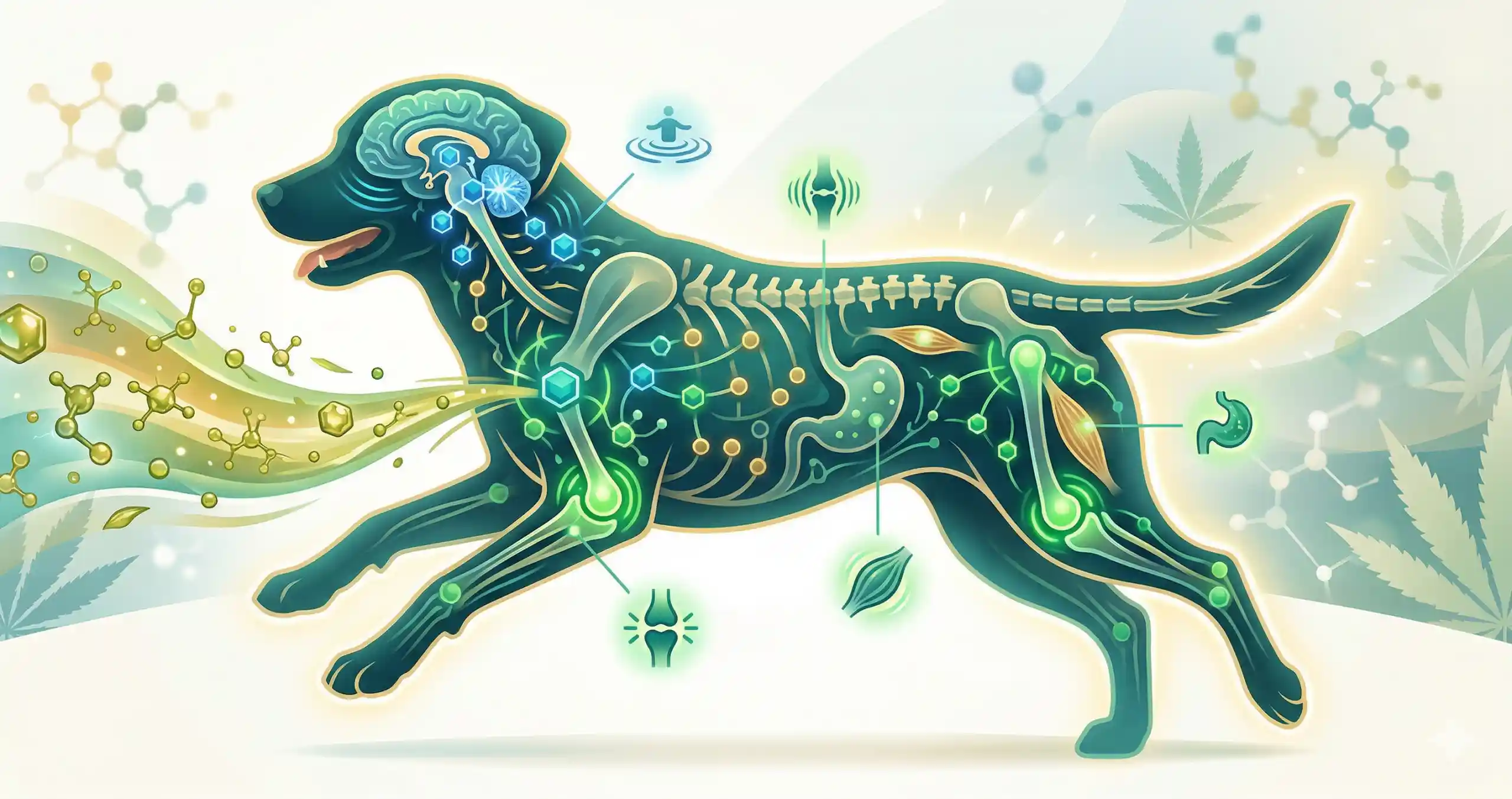
When dog owners ask how does CBD actually work — or whether CBD oil for dogs has any real scientific basis — the answer starts with one of the most important biological systems in mammalian physiology. The endocannabinoid system in dogs is a receptor network that gives cannabinoids like CBD a validated mechanism of action. Without this system, hemp-derived products would have no meaningful pathway to produce physiological effects. With it, CBD for dogs has become one of the most actively researched areas in modern veterinary medicine.
This article provides a science-backed overview of what the endocannabinoid system is, how it functions specifically in dogs, why CBD works differently than THC in the canine body, what peer-reviewed research shows about CBD safety for dogs, and how Peak Therapeutics formulations are designed around this biology.
In This Article
- What Is the Endocannabinoid System in Dogs?
- Why Dogs Have an Endocannabinoid System
- How Cannabinoids Interact with the Canine ECS
- CBD vs. THC in Dogs: A Critical Safety Distinction
- The ECS, Joint Mobility, and Comfort in Dogs
- Clinical Perspective: Dr. James S. Gaynor
- Peak Therapeutics Products for Dogs
- Frequently Asked Questions
- References
- About Dr. James S. Gaynor
Key Takeaways
- The endocannabinoid system in dogs is a biological signaling network that regulates inflammation, neurological signaling, immune function, appetite, sleep, and tissue repair.
- Dogs have a high concentration of CB1 receptors in the cerebellum and brainstem, making them highly responsive to cannabinoids and uniquely sensitive to THC.
- CBD modulates ECS receptor activity without direct CB1 activation, producing no intoxicating effects. THC binds directly to CB1 receptors and is toxic to dogs even at low doses.
- Peer-reviewed clinical trials, including the 2018 Cornell University study, show measurable benefit of CBD for canine comfort and mobility with a favorable safety profile.
- Full-spectrum CBD preserves the entourage effect, where multiple cannabinoids and terpenes work together for greater benefit than isolated CBD alone.
- Peak Therapeutics formulations are designed around canine ECS biology with species-specific concentrations and targeted cannabinoid combinations.
What Is the Endocannabinoid System in Dogs?
The endocannabinoid system (ECS) is a biological signaling network present in all mammals, including dogs. It plays a fundamental role in maintaining physiological homeostasis — the body’s ability to regulate and stabilize its internal environment in response to stress, injury, inflammation, or metabolic change.
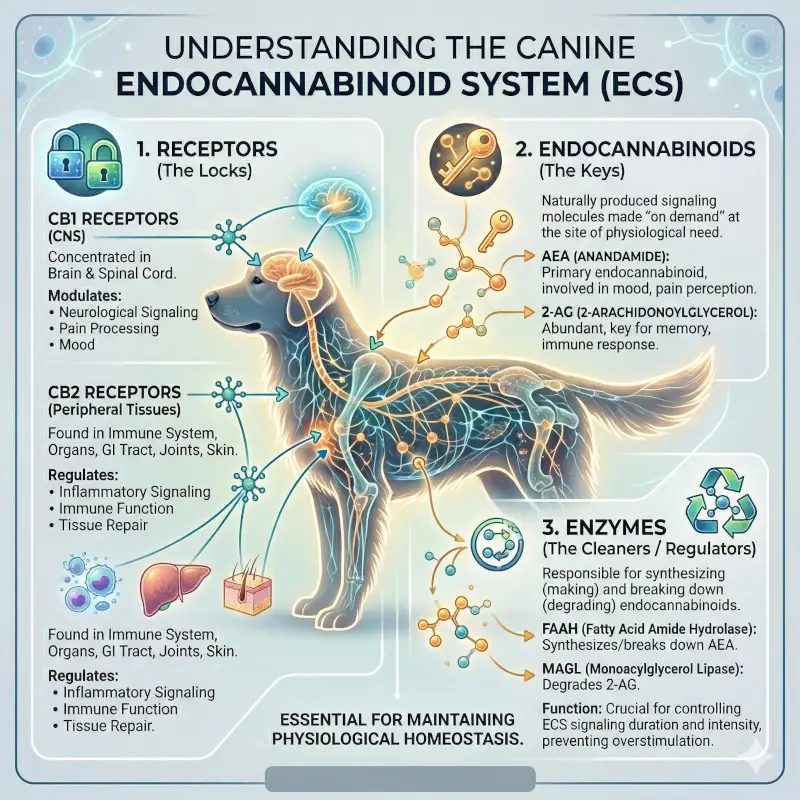 Discovered in the early 1990s during research into the mechanisms of THC, the ECS has since been recognized as one of the most important regulatory systems in mammalian biology. It is present in virtually the entire animal kingdom — from mammals and fish to primitive invertebrates. In fact, only insects and protozoa appear to function without it.
A 2024 comparative review across the main species of veterinary interest confirmed that the ECS — including CB1 and CB2 receptors, endocannabinoids, and metabolic enzymes — is conserved across dogs, cats, and horses, though with species-specific differences in receptor distribution and cannabinoid metabolism.
The ECS consists of three primary components:
| Component | Role & Function |
|---|---|
| Cannabinoid Receptors | CB1 and CB2 are the two primary receptors. CB1 receptors are concentrated in the central nervous system, while CB2 receptors are found predominantly in immune tissues and peripheral organs. Both receptor types are distributed throughout the canine body. |
| Endocannabinoids | Naturally produced signaling molecules — primarily anandamide (AEA) and 2-arachidonoylglycerol (2-AG) — that bind to cannabinoid receptors on demand to trigger regulatory responses at the site of physiological need. |
| Metabolic Enzymes | Enzymes including FAAH (fatty acid amide hydrolase) and MAGL (monoacylglycerol lipase) that synthesize and break down endocannabinoids, controlling the duration and intensity of ECS signaling and preventing receptor overstimulation. |
Together, these three components regulate inflammation, neurological signaling, immune function, appetite, sleep, mood, and tissue repair — making the ECS a biologically compelling target for veterinary nutraceuticals like CBD for dogs and hemp for dogs.
Why Dogs Have an Endocannabinoid System — And Why It Matters
All mammals share the same fundamental ECS architecture, but the endocannabinoid system in dogs has specific features that make dogs both highly responsive to cannabinoids and uniquely sensitive to certain compounds — particularly THC.
Do dogs have cannabinoid receptors? Yes — dogs have cannabinoid receptors distributed throughout the body: in the brain, spinal cord, peripheral nerves, immune cells, gastrointestinal tissues, skin, and connective tissues. Critically, dogs have a notably high concentration of CB1 receptors in the cerebellum, brainstem, and medulla oblongata — regions governing coordination, balance, and autonomic function. This anatomical difference is the primary reason dogs are significantly more sensitive to THC toxicity than humans.
CB1 receptors in the central nervous system modulate neurological signaling, pain processing, mood, and motor function. CB2 receptors in immune tissues regulate inflammatory signaling, immune cell activity, and the body’s response to tissue injury. When the ECS is functioning optimally, these receptors help produce balanced, adaptive responses. When ECS signaling is dysregulated — as may occur in chronic inflammatory conditions, age-related disease, or anxiety — targeted support through phytocannabinoids like CBD for dogs becomes clinically relevant.
“The endocannabinoid system is not just present in nearly all animals — it plays an integral role in maintaining homeostatic balance across organ systems. Understanding it is essential for understanding how CBD for pets produces meaningful physiological effects.” — Silver RJ, Animals (Basel), 2019
How Cannabinoids Interact with the Canine Endocannabinoid System
Dogs naturally produce endocannabinoids — primarily anandamide (AEA) and 2-arachidonoylglycerol (2-AG) — that bind to CB1 and CB2 receptors to regulate biological balance. These molecules are synthesized on demand and act locally at the site of need, which distinguishes them from hormones that circulate systemically.
Plant-derived cannabinoids from hemp — known as phytocannabinoids — interact with the same ECS receptors and pathways. Although endocannabinoids and phytocannabinoids differ in chemical structure, they exhibit overlapping effects through shared target receptors, signaling pathways, and metabolic enzymes. This is why CBD for dogs has attracted sustained scientific interest. The primary phytocannabinoids of veterinary relevance include:
| Phytocannabinoid | Properties & Veterinary Relevance |
|---|---|
| CBD (Cannabidiol) | Non-intoxicating; modulates CB1 and CB2 receptors indirectly; the most extensively studied phytocannabinoid in veterinary medicine. The active ingredient in all Peak Therapeutics core formulations. |
| CBG (Cannabigerol) | Non-intoxicating; the “precursor cannabinoid” from which other cannabinoids are biosynthesized; interacts directly with both CB1 and CB2 receptors. Found in Peak Therapeutics Pink Label (CBD Get Calm). |
| CBN (Cannabinol) | Non-intoxicating; formed from the oxidation of THC over time; associated with sleep support and relaxation via ECS interaction. Found in Peak Therapeutics Purple Label (CBD Night). |
| CBC (Cannabichromene) | A minor cannabinoid with growing preclinical research interest in inflammatory signaling and neurological support pathways. |
A key principle in cannabinoid medicine is the entourage effect — the finding that multiple cannabinoids, terpenes, and plant compounds working together produce greater therapeutic benefit than any isolated compound alone. As a result, this is why Peak Therapeutics uses full-spectrum, CO₂-extracted hemp that preserves the complete cannabinoid and terpene profile, rather than CBD isolate.
CBD vs. THC in Dogs: A Critical Safety Distinction
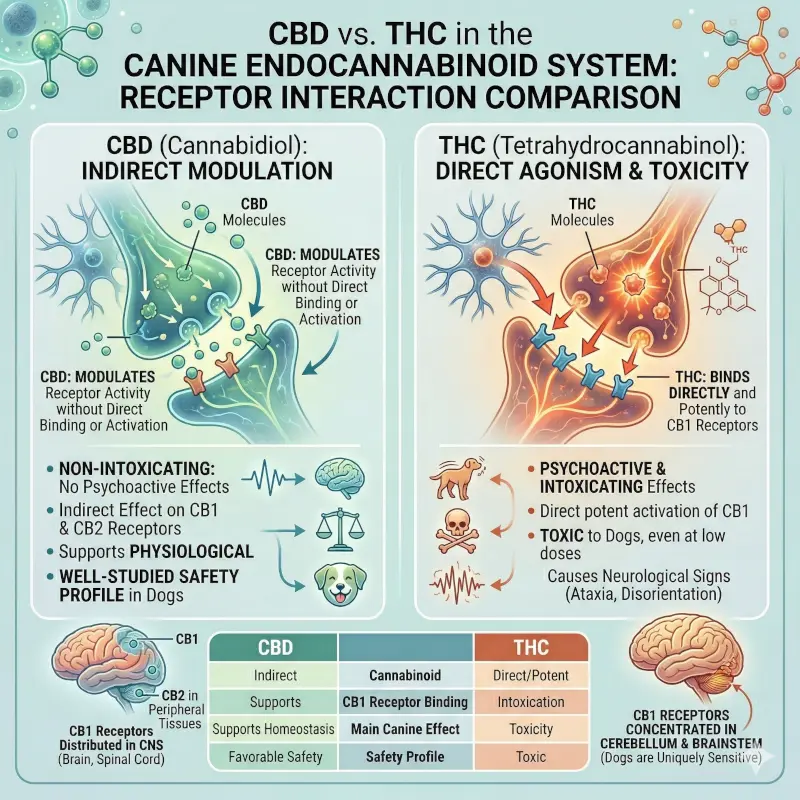 One of the most important concepts in veterinary cannabinoid medicine — and one that every dog owner considering CBD should understand — is the fundamental difference between CBD and THC and how each interacts with the endocannabinoid system in dogs.
THC (tetrahydrocannabinol) binds directly and potently to CB1 receptors in the brain, producing intoxication. THC toxicity in dogs is a serious veterinary concern — even small amounts of THC can be toxic to dogs, causing neurological signs including disorientation, ataxia (loss of coordination), hypersensitivity to stimuli, and in severe cases, seizures or cardiovascular effects. The high density of CB1 receptors in the canine cerebellum and brainstem makes dogs particularly vulnerable.
CBD (cannabidiol) does not bind directly to CB1 receptors in the same way as THC. Instead, it modulates receptor activity rather than activating it outright, producing no intoxicating effects. This distinction is the foundation of CBD’s favorable safety profile in dogs.
| Cannabinoid | Safety Profile in Dogs |
|---|---|
| THC | Binds directly to CB1 receptors; psychoactive and intoxicating; toxic to dogs even at low doses. The high density of CB1 receptors in the canine cerebellum and brainstem makes dogs especially vulnerable. Never appropriate for use in dogs. |
| CBD | Modulates ECS without direct CB1 agonism; non-intoxicating; well-studied safety profile in dogs. Appropriate in hemp-derived form (<0.3% THC). |
All Peak Therapeutics products are formulated from hemp containing less than 0.3% THC and are independently third-party tested to verify compliance and purity. Lab results are published at peaktherapeutics.net.
The ECS, Joint Mobility, and Comfort in Dogs: What the Research Shows
The area of veterinary ECS research that has attracted the most clinical attention is its role in inflammatory signaling and the neurological pathways associated with joint mobility and physical comfort — particularly in aging dogs.
Dog joint health depends on complex biological processes, and the ECS’s CB1 and CB2 receptors are present in joint synovium, connective tissue, and peripheral nerves, positioning the endocannabinoid system in dogs as a meaningful modulator of joint-related biological function.
ECS signaling influences inflammatory mediator release, nerve signal processing related to discomfort, immune system regulation, and tissue repair mechanisms. This is why CBD for dogs experiencing reduced joint mobility — including dog osteoarthritis — has become a primary focus of peer-reviewed veterinary research.
Featured Research: Cornell University College of Veterinary Medicine, 2018Study: Pharmacokinetics, Safety, and Clinical Efficacy of Cannabidiol Treatment in Osteoarthritic Dogs
Published: Front Vet Sci. 2018;5:165 (doi:10.3389/fvets.2018.00165)
Design: Randomized, double-blind, placebo-controlled crossover trial
Subjects: Dogs with confirmed osteoarthritis
Assessment: Veterinarian evaluations, owner assessments, and activity monitoring
Key Findings: Significant decrease in discomfort scores and increase in activity at CBD dosing of 2 mg/kg twice daily. No adverse effects reported by owners.
Conclusion: CBD showed measurable benefit over placebo with a favorable safety profile.
Additional Peer-Reviewed Evidence
A 2022 systematic review of all randomized clinical trials of cannabis in animal disease identified six studies meeting rigorous inclusion criteria — four in dogs with osteoarthritis, one in dogs with epilepsy, and one in dogs with behavioral disorders. Across the osteoarthritis trials, CBD significantly reduced pain and increased activity.
Overall, the review concluded there is meaningful evidence supporting CBD use in dogs for comfort and mobility, while calling for larger and more diverse clinical trials.
A 2023 review by DiSalvo et al. further confirmed evidence for a beneficial role of CBD in canine comfort, mobility, and seizure management, while identifying the need for standardized dosing protocols. Reference: DiSalvo et al., Frontiers in Veterinary Science, 2023
A 2024 comparative review across the main veterinary species synthesized the full body of published evidence on cannabinoid receptor expression, CBD pharmacokinetics, and clinical efficacy in dogs — concluding that evidence supports a beneficial role for CBD while calling for continued species-specific research.
In 2025, a pharmacokinetic study funded by Peak Therapeutics and published in Frontiers in Veterinary Science confirmed the bioavailability and safety profile of full-spectrum CBD in dogs, providing further scientific grounding for the company’s formulations.
Clinical Perspective — Dr. James S. Gaynor, DACVAA
“As a board-certified veterinary anesthesiologist with three decades focused on multimodal pain management, the endocannabinoid system represents one of the most important biological discoveries for veterinary medicine in recent history. It provides a scientifically grounded mechanism to understand why CBD for dogs has clinical potential — and it clarifies exactly why species-specific formulation, appropriate dosing, and product quality matter. Dogs are the most studied species in veterinary cannabinoid research, and the evidence base for CBD in canine comfort and mobility continues to grow. Used within a comprehensive integrative strategy, CBD for dogs represents a meaningful tool for supporting comfort, mobility, and quality of life.”
— Dr. James S. Gaynor, DACVAA, Chief Medical Officer, Peak Therapeutics
CBD for dogs should be viewed as one component of a comprehensive integrative treatment strategy that may also include rehabilitation therapy, nutritional management, pharmaceutical therapy, and regenerative medicine. Veterinary supervision and appropriate product selection remain essential.
Peak Therapeutics Products for Dogs
Every Peak Therapeutics formulation is designed with the endocannabinoid system in dogs in mind — with species-specific concentrations, full-spectrum extraction, and targeted cannabinoid combinations that align with the biology of the condition being supported.
| Product | Formulation & ECS Target |
|---|---|
| Blue / Green Label | Healthy Pet CBD (100mg/ml) — Full-spectrum CBD for everyday wellness in dogs. The primary daily wellness formulation for medium and large breed dogs. |
| Yellow Label | Hemp Extract CBD (50mg/ml) — Lower-concentration formulation designed for small dogs (and cats) for precise, comfortable dosing. |
| Pink Label | CBD Get Calm (CBD + CBG) — ECS-targeted everyday calm and comfort support. Ideal for dogs experiencing situational stress, travel anxiety, or noise sensitivity. |
| Purple Label | CBD Night (CBD + CBN) — ECS-targeted nighttime wellness and sleep support for dogs with disrupted sleep patterns or nighttime restlessness. |
| Edibles | CBD Treats (10mg each) — Consistent dosing in a convenient treat format. Uses the same CO₂-extracted full-spectrum oil as the liquid formulations. |
| EVA | Elk Velvet Antler — Joint health and muscle support through naturally occurring growth factors. Complements CBD for comprehensive mobility support. |
Full product third-party lab results:
Frequently Asked Questions About the Endocannabinoid System and CBD for Dogs
Do dogs naturally produce cannabinoids?
Yes. Dogs produce endocannabinoids — primarily anandamide (AEA) and 2-arachidonoylglycerol (2-AG) — that interact with CB1 and CB2 receptors throughout the body. These naturally occurring molecules help regulate inflammation, neurological signaling, immune function, and more.
Can CBD make my dog high?
No. CBD is non-intoxicating and does not produce the psychoactive effects associated with THC. CBD modulates ECS receptor activity rather than directly activating CB1 receptors the way THC does. All Peak Therapeutics products contain less than 0.3% THC and are third-party tested to confirm this.
Why is the endocannabinoid system important for dogs?
The ECS is a central regulatory system governing inflammation, neurological signaling, immune function, appetite, sleep, and tissue repair in all mammals. Understanding the endocannabinoid system in dogs explains why CBD can have broad relevance to canine wellness — and why targeted, species-specific formulation matters.
Is CBD safe for dogs?
Peer-reviewed research, including the 2018 Cornell University trial, a 2022 systematic review of six randomized clinical trials, and a 2024 comparative review across the main veterinary species, supports a favorable safety profile for hemp-derived CBD oil for dogs at therapeutic doses. However, mild elevation in the liver enzyme alkaline phosphatase has been noted in some studies, which is why periodic veterinary monitoring is recommended for ongoing CBD supplementation.
What is the entourage effect in CBD for dogs?
The entourage effect describes the finding that the full range of cannabinoids, terpenes, and plant compounds in hemp work together synergistically to produce greater therapeutic benefit than any single isolated compound. This is why full-spectrum CBD products are generally preferred over CBD isolate in evidence-based veterinary formulations.
Why does Peak Therapeutics use full-spectrum CBD rather than isolate?
Full-spectrum hemp preserves the complete range of cannabinoids, terpenes, and plant compounds that work together through the entourage effect — producing more comprehensive ECS support than isolated CBD alone. Peak Therapeutics uses CO₂ extraction, the cleanest solvent-free method available, to maintain this full cannabinoid and terpene profile.
Are CBD dog treats as effective as CBD oil for dogs?
CBD dog treats offer a convenient, precisely dosed format for dogs who resist liquid supplementation. However, the key factor in effectiveness is not the delivery format but the quality and concentration of the hemp extract. Peak Therapeutics CBD Treats deliver 10mg of full-spectrum hemp per treat, using the same CO₂-extracted oil found in the liquid formulations. For accurate dosing at higher therapeutic levels, liquid CBD oil for dogs allows more precise adjustment.
How should I choose the right Peak Therapeutics CBD product for my dog?
For medium and large dogs: Healthy Pet — Blue/Green Label (100mg/ml) for general wellness. Small dogs do best with Healthy Pet — Yellow Label (50mg/ml) for precise lower dosing. If your dog needs everyday calm support, consider: CBD Get Calm — Pink Label (CBD + CBG). Nighttime restlessness responds well to CBD Night — Purple Label (CBD + CBN). For joint health: EVA (Elk Velvet Antler) as a complement to CBD. Consult the product guide at peaktherapeutics.net, or speak with a veterinarian for individualized recommendations.
References
The following peer-reviewed sources support the content of this article:
[1] Silver RJ. The Endocannabinoid System of Animals. Animals (Basel). 2019;9(9):686. doi:10.3390/ani9090686
[2] Gamble LJ, Boesch JM, Frye CW, et al. Pharmacokinetics, Safety, and Clinical Efficacy of Cannabidiol Treatment in Osteoarthritic Dogs. Front Vet Sci. 2018;5:165.
[3] DiSalvo A, Conti MB, della Rocca G. Pharmacokinetics, Efficacy, and Safety of Cannabidiol in Dogs: An Update of Current Knowledge. Front Vet Sci. 2023;10:1204526.
[4] Lima TM, Santiago NR, Alves ECR, et al. Use of cannabis in the treatment of animals: a systematic review of randomized clinical trials. Anim Health Res Rev. 2022;23(1):25-38.
[5] Kitts-Morgan SE, et al. Pharmacokinetics of cannabidiol and metabolites after IV and oral administration of a full-spectrum hemp product to beagle dogs. Front Vet Sci. 2025;12.
[6] Di Salvo A, Chiaradia E, Sforna M, Della Rocca G. Endocannabinoid system and phytocannabinoids in the main species of veterinary interest: a comparative review. Vet Res Commun. 2024;48(5):2915-2941. doi:10.1007/s11259-024-10509-7
About James S. Gaynor, DVM, MS, Diplomate ACVAA
Education: BA Biology (The Colorado College), DVM (The Ohio State University), MS Cardiac Physiology (The Ohio State University)
Board Certifications: American College of Veterinary Anesthesiologists (1993), Academy of Integrative Pain Management (2004), Certified CBD Consultant, Cannabinoid Medicine Studies (2020)
Academic Career: Associate Professor and Section Head of Anesthesiology, Colorado State Univ ersity College of Veterinary Medicine (1992-2003)
Clinical and Editorial Career
Clinical Practice: Medical Director & Staff Anesthesiologist, Peak Performance Veterinary Group, Frisco, CO (2004-2021). Medical Director & Staff Anesthesiologist, Colorado Animal Specialty and Emergency, Boulder, CO (2021-2025/6). Staff Anesthesiologist, Buffalo Mountain Animal Hospital, Dillon, CO (2026-present). Medical Director & Staff Anesthesiologist, Black Dog Veterinary Anesthesia Services, Breckenridge, CO (2026-present).
Editorial Role: Associate Editor, Frontiers in Veterinary Sciences (2025-2026)
Published Books: Co-editor and author of Cannabis Therapy in Veterinary Medicine: A Complete Guide (Springer, 2021) — the definitive peer-reviewed academic textbook on veterinary cannabinoid medicine. Lead editor and author of the Handbook of Veterinary Pain Management, 3rd Edition (Mosby/Elsevier, 2015) — the gold-standard clinical reference for veterinary pain management.
Research includes a 2025 pharmacokinetic study published in Frontiers in Veterinary Science confirming the bioavailability and safety profile of full-spectrum CBD in dogs.
Peak Therapeutics was founded by Dr. Gaynor to bring the same evidence-based standards applied throughout his academic and clinical career directly to veterinary CBD and nutraceutical products.
Explore the Full Peak Therapeutics Line
Veterinarian-developed · CO₂-extracted · Full-spectrum · Third-party lab tested
Explore Our Products
© 2026 Peak Therapeutics | This blog is for informational purposes only and is not intended as veterinary medical advice. Consult your veterinarian before starting any new supplement regimen. All products contain less than 0.3% THC by weight.
Recent Comments