
When pet owners search for CBN for dogs or ask whether CBD for dogs can support nighttime rest, the answer lies in understanding how specific cannabinoids interact with the endocannabinoid system (ECS), the biological network that governs sleep, relaxation, comfort, and immune function in all mammals.
CBN (cannabinol) is one of the most compelling minor cannabinoids in veterinary wellness today, and at Peak Therapeutics, it was selected for our CBD Night formula (Purple Label) for specific, evidence-based reasons rooted in peer-reviewed science and clinical experience.
This article is a science-backed overview of what CBN is, how CBN for dogs differs from CBD for dogs, what the current research shows about cannabinol and sleep support, how the endocannabinoid system makes CBN effective in pets, and why Peak Therapeutics formulated CBD Night the way we did.
Whether you are a pet owner researching CBD oil for dogs or a veterinarian evaluating cannabinoid nutraceuticals, this guide provides the evidence and clinical context you need.
In This Article
- What Is CBN (Cannabinol)? Understanding CBN for Dogs
- CBN vs. CBD for Dogs: A Critical Comparison
- What Does CBN Do? The Science of CBN for Dogs
- The Endocannabinoid System: Why CBN Works in Pets
- CBN and Sleep Support: What the Research Shows
- Why CBN Is in Our CBD Night Formula
- Clinical Perspective: Dr. James S. Gaynor, DACVAA
- How CBD Night Fits the Full Peak Therapeutics Product Line
- How to Use CBD Night for Dogs
- Frequently Asked Questions About CBN for Dogs
- References
- About Dr. James S. Gaynor
Key Takeaways: CBN for Dogs
- CBN (cannabinol) is a non-intoxicating cannabinoid formed when THC oxidizes. It has a well-established safety profile and is specifically associated with sleep support and relaxation in dogs.
- CBN and CBD serve different roles. CBD provides broad everyday wellness support, while CBN targets nighttime calm, muscle relaxation, and restful sleep through the endocannabinoid system and possible GABA modulation.
- Research supports the combination. A 2024 randomized, double-blind, placebo-controlled trial found that CBN combined with CBD significantly improved sleep quality scores compared to placebo.
- The entourage effect matters. Full-spectrum formulas combining multiple cannabinoids produce more targeted results than isolated compounds, which is why CBD Night (Purple Label) pairs CBN with CBD.
- Every Peak Therapeutics product is veterinarian-developed, CO₂-extracted, full-spectrum, and independently third-party lab tested.
1. What Is CBN (Cannabinol)? Understanding CBN for Dogs
CBN stands for cannabinol, a naturally occurring cannabinoid found in the hemp plant. Unlike CBD for dogs, which is directly synthesized by the plant, CBN is formed when THC oxidizes over time. As hemp ages and is exposed to heat or light, THC slowly converts into CBN. This process produces a compound with very little to no psychoactive effect, making it safe, non-intoxicating, and well-suited for use in pets.
Notably, CBN holds a significant place in the history of cannabinoid science: it was the first cannabinoid ever isolated by researchers in the 1930s, predating the discovery of both CBD and THC. Despite this long history, it is only in recent years that scientists have begun to systematically explore its full therapeutic potential, particularly in relation to sleep support, relaxation, and comfort in companion animals.
Understanding the distinction between CBN for dogs and CBD for dogs is key to understanding why CBD Night (Purple Label) is a fundamentally different product from standard CBD formulas, not just a different color cap, but a different clinical tool designed for a specific purpose.
2. CBN vs. CBD for Dogs: A Critical Comparison
One of the most important concepts in veterinary cannabinoid medicine, and one that every pet owner considering CBD for pets should understand, is the fundamental difference between CBN and CBD. Both are non-intoxicating cannabinoids derived from hemp, but they serve different clinical roles.
| Property | CBN (Cannabinol) | CBD (Cannabidiol) |
|---|---|---|
| Origin | Formed from oxidation of THC over time | Directly synthesized by the hemp plant |
| Psychoactive? | No, non-intoxicating | No, non-intoxicating |
| Primary Role | Sleep support, calm, relaxation | Broad everyday wellness support |
| Mechanism | ECS; possible GABA modulation | ECS; broad receptor interaction |
| ECS Receptor Affinity | Interacts with both CB1 and CB2; mild CB1 partial agonist | Modulates CB1 and CB2 indirectly; no direct agonism |
| In CBD Night? | Yes, key complementary cannabinoid | Yes, full-spectrum base formula |
3. What Does CBN Do? The Science of CBN for Dogs
CBN for dogs research is still emerging, as is true of most cannabinoid science, but the early findings are compelling, particularly for sleep and relaxation support. Here is what the current evidence points to:
Sleep Support: CBN has long been associated with sedative properties. Research and clinical observations suggest CBN may support drowsiness and promote longer, more restful sleep cycles, particularly when combined with CBD. A 2024 randomized, double-blind, placebo-controlled human trial found that CBN combined with CBD significantly improved sleep quality scores compared to placebo.
Muscle Relaxation: In addition, studies have indicated that CBN may act as a muscle relaxant, helping ease tension and physical restlessness that can prevent quality sleep in dogs and other companion animals.
Appetite Stimulation: Preclinical studies also suggest CBN may gently stimulate appetite, which can be valuable for pets recovering from illness, surgery, or periods of stress-related appetite suppression.
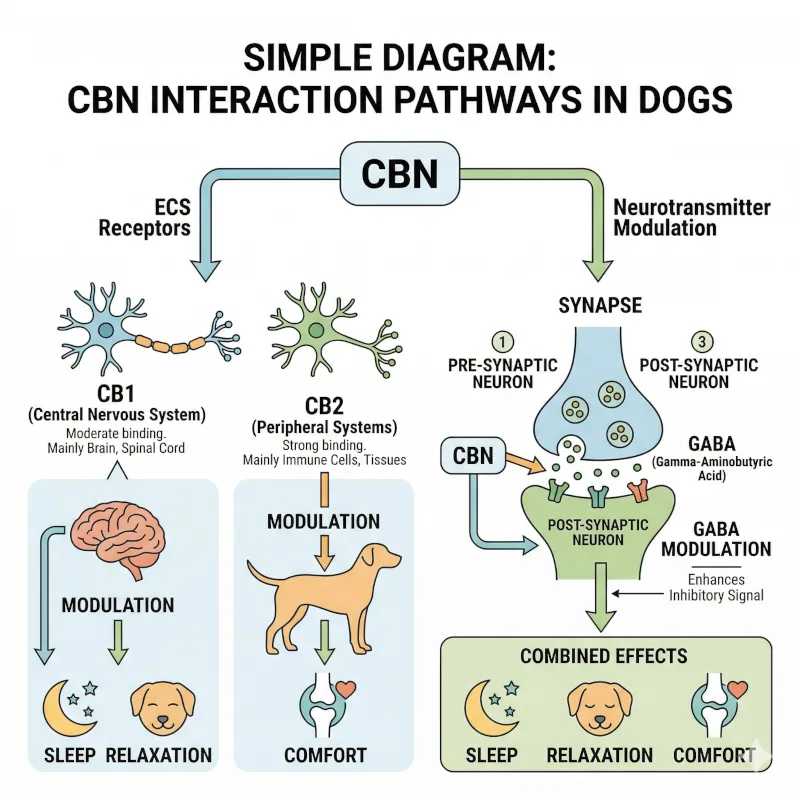 Comfort and Inflammatory Pathway Support: Similarly, CBN appears to interact with the body’s inflammatory pathways through the endocannabinoid system, potentially contributing to overall physical ease and calm in dogs.
The Entourage Effect with CBD: CBN is believed to work synergistically with CBD for dogs, each amplifying the other’s effects.
This pharmacological synergy, known as the entourage effect, is a core reason why combining them in one formula produces more targeted results than either compound alone. Research has shown that multiple cannabinoid compounds show potential for supporting sleep through ECS interactions, and that CBN may potentiate the effects of other cannabinoids.
4. The Endocannabinoid System: Why CBN Works in Pets
To understand why CBN for dogs is effective, it helps to understand the endocannabinoid system (ECS), the biological network through which all cannabinoids exert their effects. The ECS is present in all mammals, including dogs, cats, and horses.
It is a complex cell-signaling system involving receptors (CB1 and CB2), naturally produced endocannabinoids, and enzymes that regulate a wide range of physiological processes including sleep, mood, comfort, immune response, and appetite.
A 2024 comparative review confirmed that the ECS is conserved across the main species of veterinary interest, with species-specific differences in receptor distribution and cannabinoid metabolism.
| ECS Component | Role and Function in Dogs |
|---|---|
| CB1 Receptors | Found predominantly in the brain and central nervous system. Closely associated with sleep regulation, neurological calm, pain processing, and motor function. Dogs have notably high CB1 density in the cerebellum and brainstem. |
| CB2 Receptors | Found primarily in immune tissues and peripheral organs. Associated with the body’s inflammatory response, immune cell activity, and tissue repair mechanisms. |
| Endocannabinoids | Naturally produced signaling molecules, primarily anandamide (AEA) and 2-arachidonoylglycerol (2-AG), that bind to CB1 and CB2 receptors on demand to trigger regulatory responses. |
| Metabolic Enzymes | Enzymes including FAAH and MAGL that synthesize and break down endocannabinoids, controlling the duration and intensity of ECS signaling. |
Because CBN appears to interact with both CB1 and CB2 receptor types, as well as potentially influencing GABA pathways, an inhibitory neurotransmitter system associated with relaxation and sedation, its effects are specifically relevant to nighttime wellness. In particular, CBN’s receptor interactions align closely with the biological mechanisms of sleep and relaxation, making it a logical and targeted addition to a nighttime formula for dogs.
5. CBN and Sleep Support: What the Research Shows
The area of CBN research that has attracted the most attention is its role in supporting sleep and relaxation. While large-scale controlled veterinary trials specifically on CBN remain limited, as with much of cannabinoid science, the available evidence from preclinical research, human clinical trials, and clinical observation provides compelling scientific grounding.
Featured Research: Randomized Controlled Trial, CBN and CBD for Sleep Quality (2024)
Study: A Double-Blind, Randomized, Placebo-Controlled Study of the Safety and Effects of CBN With and Without CBD on Sleep Quality
Published: J Clin Psychol. 2024;80(3):652-664 (doi:10.1002/jclp.23600)
Design: Randomized, double-blind, placebo-controlled
Key Findings: The combination of CBN with CBD produced statistically significant improvements in sleep quality scores compared to placebo. Additionally, CBN was well-tolerated with a favorable safety profile.
A 2021 review in Cannabis and Cannabinoid Research examined the historical and emerging evidence around CBN and sleep, noting that while early research attributed sedative properties to CBN, rigorous controlled data was only beginning to accumulate. The review called for further investigation while acknowledging the compound’s longstanding association with relaxation and drowsiness.
Meanwhile, a separate 2021 review in Neurotherapeutics examined the broader effects of cannabinoids on sleep, finding that multiple cannabinoid compounds show potential for supporting sleep through ECS interactions, and that combination approaches (such as CBD + CBN) may be particularly effective.
Furthermore, classical pharmacological research dating to 1975 provided early evidence that CBN may potentiate the sedative effects of THC in human subjects, establishing CBN’s role in the broader pharmacological understanding of cannabinoid interactions and the entourage effect.
6. Why CBN Is in Our CBD Night Formula
When Dr. Gaynor developed the CBD Night (Purple Label) formula, the clinical goal was clear: create a product specifically designed to support rest, calm, and nighttime recovery in pets, not simply a standard CBD oil for dogs with a different label. CBN was chosen as the key complementary cannabinoid for three evidence-based reasons:
1. Its Specific Nighttime Profile: While CBD for dogs provides broad everyday wellness support, CBN is the cannabinoid most closely associated with sedation and relaxation in the scientific literature. Consequently, combining them in CBD Night targets nighttime needs more precisely than CBD alone, addressing sleep, muscle tension, and restlessness together.
2. The Synergistic Entourage Effect: CBD and CBN work better together than in isolation. The entourage effect, where multiple cannabinoids enhance each other’s activity, means the full-spectrum CBD Night formula delivers more complete nighttime support than an isolated CBD product. For this reason, Peak Therapeutics uses CO₂-extracted, full-spectrum hemp to preserve this synergy.
3. Safety in Pets: CBN has a well-established safety profile. It is non-psychoactive and non-toxic, and does not produce the intoxicating effects associated with THC. Dr. Gaynor selected it because it meets the same rigorous clinical safety standards he applies to every Peak Therapeutics formulation. All products are independently third-party lab tested to verify potency and purity.
7. Clinical Perspective: Dr. James S. Gaynor, DACVAA
“As a board-certified veterinary anesthesiologist with three decades focused on multimodal pain management, I developed CBD Night because I saw a clear clinical need for targeted nighttime cannabinoid support in pets. CBN’s specific receptor interactions and its synergy with CBD through the entourage effect make it the ideal complementary cannabinoid for sleep and relaxation. This is not a marketing decision, it is a formulation built on the same evidence-based principles I have applied throughout my academic and clinical career. Every ingredient in CBD Night is present for a clinical reason.”
Dr. James S. Gaynor, DACVAA, Chief Medical Officer, Peak Therapeutics
This transparency is intentional. Dr. Gaynor applies the same evidence standards to nutraceutical formulations that he applies to pharmaceutical decisions in clinical practice. When the science is emerging, Peak Therapeutics says so and explains the clinical reasoning behind every formulation choice. For a full clinical overview of cannabinoid pharmacology in veterinary patients, see: Cannabis Therapy in Veterinary Medicine (Springer, 2021), co-edited and co-authored by Dr. Gaynor.
It is also important to recognize that CBD for dogs and CBN for dogs should be viewed as components of an integrative treatment strategy that may also include rehabilitation therapy, nutritional management, pharmaceutical therapy, and regenerative medicine. Veterinary supervision and appropriate product selection remain essential when incorporating nutraceuticals into clinical care.
8. How CBD Night Fits the Full Peak Therapeutics Product Line
Understanding where CBD Night sits within the broader Peak Therapeutics product family helps pet owners make the best choices for their animals. Every Peak Therapeutics formulation is designed with the endocannabinoid system in mind, with species-specific concentrations, full-spectrum extraction, and targeted cannabinoid combinations.
| Product | Formulation and ECS Target |
|---|---|
| Blue / Green Label | Healthy Pet CBD (100mg/ml) — Full-spectrum CBD for everyday wellness in dogs and cats. |
| Yellow Label | Hemp Extract CBD (50mg/ml) — Species-specific formulation for cats and small dogs. |
| Pink Label | CBD Get Calm (CBD + CBG) — ECS-targeted everyday calm and comfort support. |
| Purple Label | CBD Night (CBD + CBN) — ECS-targeted nighttime wellness and sleep support. The focus of this article. |
| Edibles | CBD Treats (10mg each) — Consistent dosing in a convenient treat format. |
| EVA | Elk Velvet Antler — Joint health and muscle support through naturally occurring growth factors. |
In practice, many pet owners use the standard Blue/Green Label CBD for dogs during the day for general wellness and then switch to CBD Night in the evening for targeted nighttime support. This combined approach mirrors the multimodal philosophy Dr. Gaynor has applied throughout his clinical career, using targeted tools at the right times rather than a one-size-fits-all approach.
Full product guide and third-party lab results: peaktherapeutics.net
9. How to Use CBD Night for Dogs
CBD Night is designed for evening use, ideally 30 to 60 minutes before your pet’s bedtime, or during periods of expected stress such as thunderstorms, fireworks, travel, or post-procedure recovery.
CBD Night Dosing Guide for Dogs
- Give 30 to 60 minutes before bedtime for best results
- Can be added directly to food or given orally
- Use the dosing chart at peaktherapeutics.net as your starting guide
- Start low and adjust gradually; every pet responds differently
- Safe for nightly use as part of a consistent routine
As always, consult your veterinarian before starting any new supplement, especially if your pet is on other medications or has an underlying health condition. Peak Therapeutics products are independently third-party lab tested; results are available at peaktherapeutics.net.
10. Frequently Asked Questions About CBN for Dogs and CBD for Dogs
Is CBN safe for dogs and cats?
Yes. CBN is non-psychoactive and non-toxic. It does not produce the intoxicating effects of THC and has a well-established safety profile in mammals. All Peak Therapeutics products are independently third-party lab tested to verify potency and the absence of harmful contaminants.
What is the difference between CBN and CBD for dogs?
CBN for dogs is specifically associated with sleep support, relaxation, and calm through the endocannabinoid system and possible GABA modulation.
In contrast, CBD for dogs provides broader everyday wellness support through indirect modulation of CB1 and CB2 receptors. Both are non-intoxicating, but they serve different clinical purposes, which is why Peak Therapeutics combines them in the CBD Night formula.
Will CBN make my dog drowsy during the day?
CBD Night is formulated specifically for nighttime use. If given during the day, some pets may appear more relaxed than usual. Because of this, we recommend using it in the evening to align with your pet’s natural sleep cycle and to get the most targeted benefit from the CBN for dogs formula.
Can I use CBD Night alongside other Peak Therapeutics CBD products?
Yes. Many pet owners use our standard CBD for dogs formula during the day and CBD Night at night. This approach is consistent with the multimodal philosophy behind Dr. Gaynor’s formulations. Always introduce any new product gradually and consult your veterinarian if your pet is on other medications.
How is CBN different from melatonin for sleep support in dogs?
Melatonin works by regulating the sleep-wake cycle through hormone signaling via the pineal gland. By contrast, CBN for dogs works through the endocannabinoid system, supporting relaxation and calm at a neurological and physiological level. They operate through different mechanisms, and some pet owners find cannabinoid-based support more effective for their animals, particularly where stress and anxiety are contributing factors to poor sleep.
Is CBN oil for dogs the same as CBD oil for dogs?
No. CBN oil for dogs and CBD oil for dogs contain different cannabinoids with different mechanisms and clinical profiles. Specifically, CBN is most closely associated with sleep and sedation support, while CBD provides broad daily wellness benefits. Peak Therapeutics CBD Night combines both in a single full-spectrum formula designed specifically for nighttime use.
Is CBD Night safe for long-term nightly use in dogs?
Based on current evidence and Dr. Gaynor’s clinical experience, CBD Night is considered safe for ongoing nightly use in dogs. As with any supplement, periodic check-ins with your veterinarian are always a sound practice, especially for pets with other health conditions.
Can CBD make my dog high?
No. CBD is non-intoxicating and does not produce the psychoactive effects associated with THC. Instead, CBD modulates ECS receptor activity rather than directly activating CB1 receptors the way THC does. All Peak Therapeutics products contain less than 0.3% THC and are third-party tested to confirm this.
What is the entourage effect in CBD and CBN for dogs?
The entourage effect describes the finding that the full range of cannabinoids, terpenes, and plant compounds in hemp work together synergistically to produce greater therapeutic benefit than any single isolated compound. This is why full-spectrum CBD products, and targeted combinations like CBD + CBN in CBD Night, are preferred over CBD isolate in evidence-based veterinary formulations.
What makes Peak Therapeutics CBD different from other pet CBD brands?
Peak Therapeutics was founded by Dr. James Gaynor, a board-certified veterinary anesthesiologist (DACVAA) and co-editor of the academic textbook on veterinary cannabinoid medicine. Every formulation is built on clinical reasoning, not marketing trends. Our products are CO₂-extracted, full-spectrum, and third-party tested. CBD Night is not a CBD oil for dogs with a different label; it is a distinct clinical tool designed for a specific nighttime purpose.
How should a pet owner choose the best CBD and CBN for dogs?
Healthy Pet, Yellow Label for cats and small dogs; Healthy Pet, Blue/Green Label for general dog wellness; CBD Get Calm, Pink Label (CBD + CBG) for everyday calm; CBD Night, Purple Label (CBD + CBN) for nighttime sleep support; EVA for joint health and muscle support. Consult the product guide at peaktherapeutics.net, or speak with a veterinarian for individualized recommendations.
11. References
The following peer-reviewed sources support the content of this article:
[1] Corroon J. Cannabinol and Sleep: Separating Fact from Fiction. Cannabis Cannabinoid Res. 2021;6(5):366-371. doi:10.1089/can.2021.0006
[2] Kaul M, Zee PC, Bhatt AS. Effects of Cannabinoids on Sleep and their Therapeutic Potential for Sleep Disorders. Neurotherapeutics. 2021;18(1):217-227.
[3] Karniol IG, Shirakawa I, Takahashi RN, Knobel E, Musty RE. Effects of delta9-tetrahydrocannabinol and cannabinol in man. Pharmacology. 1975;13(6):502-512.
[4] Corroon J, et al. A double-blind, randomized, placebo-controlled study of the safety and effects of CBN with and without CBD on sleep quality. J Clin Psychol. 2024;80(3):652-664.
[5] Silver RJ. The Endocannabinoid System of Animals. Animals (Basel). 2019;9(9):686. doi:10.3390/ani9090686
[6] Gaynor JS, et al. (eds). Cannabis Therapy in Veterinary Medicine: A Complete Guide. Springer, 2021.
[7] Di Salvo A, Chiaradia E, Sforna M, Della Rocca G. Endocannabinoid system and phytocannabinoids in the main species of veterinary interest: a comparative review. Vet Res Commun. 2024;48(5):2915-2941.
[8] Kitts-Morgan SE, et al. Pharmacokinetics of cannabidiol and metabolites after IV and oral administration of a full-spectrum hemp product to beagle dogs. Front Vet Sci. 2025;12.
12. About Dr. James S. Gaynor, DVM, MS, Diplomate ACVAA
Education: BA Biology (The Colorado College), DVM (The Ohio State University), MS Cardiac Physiology (The Ohio State University)
Board Certifications: American College of Veterinary Anesthesiologists (1993), Academy of Integrative Pain Management (2004), Certified CBD Consultant, Cannabinoid Medicine Studies (2020)
Academic Career: Associate Professor and Section Head of Anesthesiology, Colorado State University College of Veterinary Medicine (1992-2003)
Clinical Practice: Medical Director and Staff Anesthesiologist, Peak Performance Veterinary Group, Frisco, CO (2004-2021); Medical Director and Staff Anesthesiologist, Colorado Animal Specialty and Emergency, Boulder, CO (2021-2025/6); Staff Anesthesiologist, Buffalo Mountain Animal Hospital, Dillon, CO (2026-present); Medical Director and Staff Anesthesiologist, Black Dog Veterinary Anesthesia Services, Breckenridge, CO (2026-present)
Editorial Role: Associate Editor, Frontiers in Veterinary Sciences (2025-2026)
Published Books: Co-editor and author of Cannabis Therapy in Veterinary Medicine: A Complete Guide (Springer, 2021), the definitive peer-reviewed academic textbook on veterinary cannabinoid medicine. Lead editor and author of the Handbook of Veterinary Pain Management, 3rd Edition (Mosby/Elsevier, 2015), the gold-standard clinical reference for veterinary pain management.
Research includes a 2025 pharmacokinetic study published in Frontiers in Veterinary Science confirming the bioavailability and safety profile of full-spectrum CBD in dogs.
Peak Therapeutics was founded by Dr. Gaynor to bring the same evidence-based standards applied throughout his academic and clinical career directly to veterinary CBD and nutraceutical products.
Ready to Try CBD Night (Purple Label)?
Veterinarian-developed · CO₂-extracted · Full-spectrum · Third-party lab tested
© 2026 Peak Therapeutics | This blog is for informational purposes only and is not intended as veterinary medical advice.
Consult your veterinarian before starting any new supplement regimen. All products contain less than 0.3% THC by weight.
Recent Comments