

CBG for dogs explained — what cannabigerol is, how it differs from CBD, the calming terpenes linalool and limonene, and a practical framework for using a full-spectrum CBD:CBG formula to support everyday calm, written by a board-certified veterinary specialist.
Quick Answer: What Is CBG for Dogs?
CBG (cannabigerol) is a non-intoxicating compound from the hemp plant. It is often called the “mother cannabinoid” because it is the chemical precursor the plant uses to build CBD and other cannabinoids. In dogs, CBG works through the endocannabinoid system — the same receptor network CBD acts on — but with its own distinct pharmacology, which is why CBG and CBD are increasingly combined in full-spectrum calming products.
In This Article
- What Is CBG? The “Mother Cannabinoid” Explained
- Where Do CBG and CBD Act? The Canine Endocannabinoid System
- How Does CBG Work in Dogs? Mechanism of Action
- CBG vs. CBD for Dogs: What Is the Difference?
- Why Combine CBG and CBD? The Entourage Effect & the 10:1 Ratio
- What Do Linalool & Limonene Do? The Calming Terpenes
- How Do You Know If a Dog Is Unsettled? An Owner’s Guide
- When Does Calm Support Help? Everyday Situations
- How Does CBG Fit a Multimodal Calm & Composure Plan?
- How Do You Use CBG for Dogs? Dosing, Timing & Safety
- Peak Therapeutics CBD Get Calm (Pink Label): Formulation & Quality
- A Brief History: Cannabinoids in Veterinary Medicine
- Frequently Asked Questions — CBG for Dogs
- References
- About Dr. James S. Gaynor, DVM, MS, DACVAA
Key Takeaways: CBG for Dogs
- CBG is the “mother cannabinoid.” Cannabigerol is the chemical precursor from which CBD, THC, and other cannabinoids are formed in the hemp plant — a distinct compound with its own pharmacology, not simply a form of CBD.
- CBG for dogs and CBD work through complementary pathways. CBD modulates the endocannabinoid system mostly indirectly, while CBG behaves as a partial agonist at CB2 receptors and interacts with α₂-adrenoceptors and 5-HT1A serotonin receptors — a profile relevant to calm and composure.
- The entourage effect is the rationale for combining them. A full-spectrum formula keeps cannabinoids and terpenes together, which preclinical work suggests produces greater combined activity than any single isolated compound.
- Calming terpenes add a second layer. Linalool (the calming compound in lavender) and limonene (from citrus) have preclinical evidence for promoting relaxation, and may complement cannabinoids in supporting a settled, restful state.
- Position CBG for dogs as everyday calm support — not a treatment. Hemp-derived cannabinoids are best framed as wellness support for composure during routine challenges, used within a broader behavioral and veterinary plan.
Why Owners Are Asking About CBG for Dogs
Over the past few years, the questions I field from dog owners about hemp-derived cannabinoids have shifted. Early on, almost every conversation was about CBD. Increasingly, owners and referring veterinarians are asking me specifically about CBG for dogs — cannabigerol — and how it relates to the calming products they are already familiar with. It is a good question, and it deserves a careful answer. CBG for dogs is an area where the science is genuinely interesting, the marketing is often ahead of the evidence, and a measured, mechanism-based explanation is overdue.
This guide is written for both veterinarians and the dog owners they advise. I cover what CBG actually is and why it is called the “mother cannabinoid,” how cannabigerol behaves differently from CBD at the receptor level, why the two are combined in a full-spectrum formula, the role of the calming terpenes linalool and limonene, how to recognize when a dog is genuinely unsettled, and a practical framework for using a CBD:CBG product as part of a broader calm-and-composure plan. As with everything I write for Peak Therapeutics, the goal is good reference information first — grounded in the same evidence standards I have applied throughout three decades of clinical practice in veterinary anesthesia and pain management.
One framing note before we begin. Throughout this article I describe CBG and full-spectrum hemp as support for everyday calm, composure, relaxation, and behavioral balance. I do this deliberately. Hemp-derived cannabinoids are wellness ingredients, not approved drugs, and they should not be described as treating, preventing, or curing any diagnosed behavioral condition. That is not a marketing dodge — it reflects how I believe these compounds are most honestly and most usefully understood.
1. What Is CBG? The “Mother Cannabinoid” Explained
CBG (cannabigerol) is a non-intoxicating cannabinoid produced by the hemp plant. It is a distinct compound — not a variant or a stronger version of CBD. If you have spent any time reading hemp product labels, you have seen CBD. CBG is less familiar, and that first distinction is the one worth establishing clearly: the hemp plant produces over 100 different cannabinoids, and CBG occupies a special position among them.
Why It Is Called the “Mother Cannabinoid”
CBG is often called the “mother cannabinoid” or the “precursor cannabinoid.” The reason is biochemical. Inside the growing hemp plant, the acidic form of CBG — cannabigerolic acid (CBGA) — is the parent molecule from which the plant’s enzymes synthesize the acidic precursors of CBD, THC, and CBC. In other words, CBD literally begins its life as CBG. As the plant matures, most of the CBGA is converted onward into other cannabinoids, which is why mature hemp typically contains only about 1% CBG or less, and why CBG was, for many years, the harder and more expensive cannabinoid to obtain in meaningful quantities.
Two Practical Implications for CBG for Dogs
Two practical points follow from this. First, because so little CBG remains in a typical harvest, a product that delivers a clinically interesting amount of CBG has been deliberately formulated to do so. Second — and this is the part that matters most for CBG for dogs — CBG has its own pharmacology. It engages the body’s receptors in a pattern that overlaps with, but is not identical to, CBD. Understanding that difference is the foundation of the rest of this article, and it begins with the system both compounds act upon: the endocannabinoid system.
2. Where Do CBG and CBD Act? The Canine Endocannabinoid System
The endocannabinoid system (ECS) is a lipid-based signaling network present in all mammals — dogs included. It is, in essence, one of the body’s master regulatory systems, helping keep many physiological processes within a healthy operating range: comfort signaling, nervous-system tone, immune and inflammatory balance, gastrointestinal function, and the regulation of stress responses. When people ask me why hemp cannabinoids would do anything at all in a dog, the ECS is the answer: dogs come equipped with the receptors these compounds engage. The two principal cannabinoid receptors, CB1 and CB2, were first characterized in the early 1990s, and the ECS has since been confirmed across virtually every vertebrate species examined.
The Canine ECS Has Three Working Parts
ECS Component |
Role in the Dog |
|---|---|
| CB1 receptors | Concentrated in the brain and central nervous system — including regions that govern emotional tone, stress responses, and how a dog perceives and processes its environment. Also present on peripheral nerves. CB1 signaling is central to nervous-system balance and composure. |
| CB2 receptors | Found mainly on immune cells and in peripheral tissues, including the gastrointestinal tract. CB2 receptors help regulate inflammatory signaling. CB2 is the receptor where CBG shows its clearest activity — a key point for Section 3. |
| Endocannabinoids | The body’s own internal cannabinoids — principally anandamide and 2-AG — produced on demand to fine-tune signaling at the synapse, then broken down by dedicated enzymes (FAAH and MAGL). |
Why This Matters for Hemp Cannabinoids
Phytocannabinoids — cannabinoids made by the hemp plant, such as CBD and CBG — work because they interact with this same receptor architecture. They do not introduce a foreign system into the dog; they engage one the dog already has. This is the rational, mechanism-based reason that CBG for dogs can support a calm, balanced state, rather than a wellness trend without a biological footing.
3. How Does CBG Work in Dogs? Mechanism of Action
Dog-specific CBG research is still limited, so the mechanistic picture below is built primarily from molecular pharmacology and preclinical research, applied to the canine ECS described above. I want to be transparent about that: this is a mechanism-based rationale, not a claim of proven clinical effect in dogs. With that caveat stated plainly, here is what the science indicates about how cannabigerol behaves.
CBG’s Receptor Activity and Why It Matters
CBG Mechanism |
Why It Is Relevant to Calm & Composure in Dogs |
|---|---|
| CB2 receptor partial agonism | Receptor studies show CBG acts as a partial agonist at CB2 receptors — it engages and lightly activates them. Because CB2 receptors help regulate inflammatory signaling, this is one route by which CBG may support balance in tissues, including pathways that intersect with comfort. |
| Measurable activity at CB1 | CBG also produces measurable effects at CB1 receptors, though the underlying molecular detail is still being clarified. Importantly, CBG is non-intoxicating: it does not produce the CB1-driven intoxication associated with THC. |
| α₂-adrenoceptor interaction | CBG is somewhat unusual among cannabinoids in interacting with α₂-adrenoceptors — the same receptor family targeted by several calming agents used in veterinary medicine. This interaction is part of why CBG attracts interest as a composure-supporting compound. |
| 5-HT1A serotonin receptor activity | Like CBD, CBG shows activity at 5-HT1A serotonin receptors, which are involved in emotional tone and the regulation of stress responses — a pathway plausibly relevant to a settled, balanced demeanor. |
| Modulation of endocannabinoid tone | Taken together, the receptor data suggest CBG functions as a regulator of endocannabinoid signaling — nudging the system rather than overdriving it. This “modulatory” character is consistent with support for balance rather than heavy sedation. |
The Headline for Owners
The headline for owners is this: CBG’s receptor profile — partial CB2 agonism plus activity at α₂-adrenoceptors and 5-HT1A receptors — touches several pathways associated with nervous-system tone and composure. It does so through gentle modulation, which is consistent with the practical goal of a product like ours: supporting a calm, settled state without dulling a dog’s natural alertness or personality.
4. CBG vs. CBD for Dogs: What Is the Difference?
CBG and CBD come from the same plant and are chemically related, but they are not interchangeable: CBD acts mostly as an indirect modulator of the endocannabinoid system, while CBG behaves as a partial agonist at CB2 receptors and adds α₂-adrenoceptor activity that CBD does not share. Because owners almost always arrive already knowing something about CBD, the most useful way to explain CBG for dogs is by direct comparison.
Key Differences Between CBD and CBG
Feature |
CBD vs. CBG |
|---|---|
| Origin in the plant | CBG (as CBGA) is the precursor; CBD is one of the cannabinoids the plant builds from it. CBG is the “parent,” CBD the “descendant.” |
| Primary receptor behavior | CBD acts largely as an indirect modulator — it influences the ECS without strongly activating CB1 or CB2 directly. CBG behaves as a partial agonist at CB2 and interacts more directly with the receptor system overall. |
| Distinctive targets | Both touch 5-HT1A serotonin receptors. CBG is additionally notable for α₂-adrenoceptor interaction — a feature CBD does not share to the same degree. |
| Intoxication | Neither is intoxicating. Both lack the CB1-driven psychoactive effect of THC, which is why hemp-derived products kept below 0.3% THC are non-intoxicating for dogs. |
| Best understood as | Not competitors, but complements. CBD provides broad ECS modulation; CBG adds a partially overlapping but distinct receptor profile. Used together, they cover more pathways than either alone. |
The Family Metaphor
I find the family metaphor genuinely useful when I explain this in an exam room. CBG is the parent compound; CBD is one of its offspring. They share a resemblance, but each has its own character. And as with any good partnership, the interesting question is not “which one is better” — it is “what do they do together.” That is the entourage effect, and it is the subject of the next section.
5. Why Combine CBG and CBD? The Entourage Effect & the 10:1 Ratio
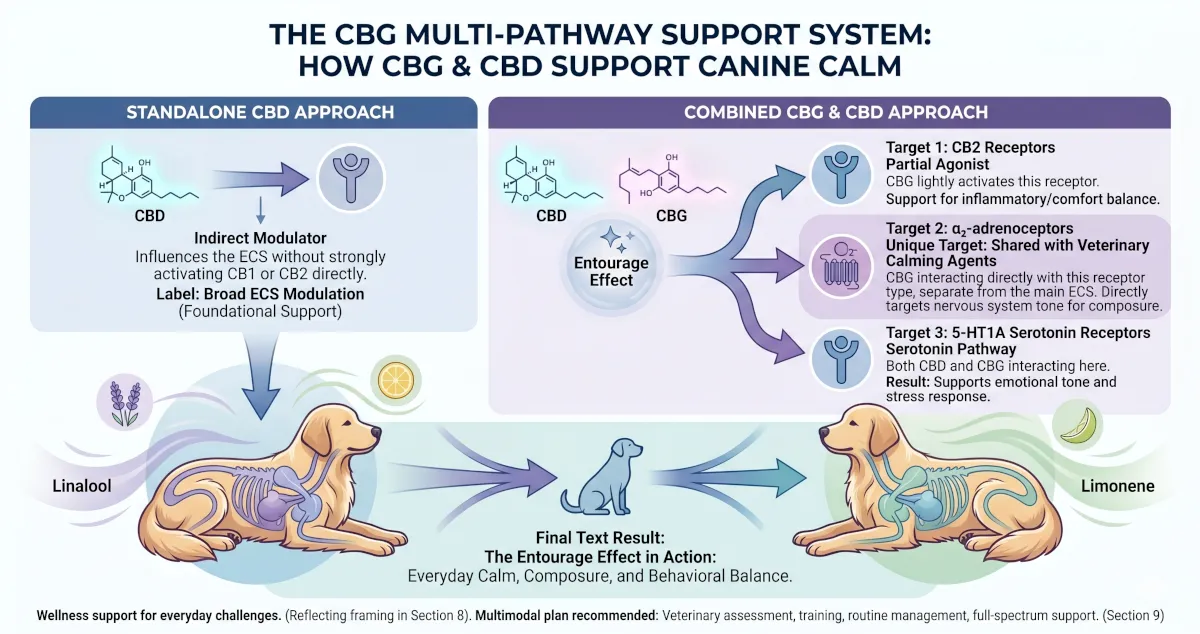 The entourage effect is the well-described observation that the cannabinoids and terpenes of the hemp plant tend to produce greater combined biological activity when they act together than any single isolated compound does on its own. It is the central reason I formulate Peak Therapeutics products as full-spectrum rather than as isolated single compounds.
A full-spectrum extract preserves the plant’s natural matrix — CBD and CBG together with minor cannabinoids and the aromatic terpenes — instead of stripping everything away to leave one purified molecule. The practical consequence is that the parts can reinforce one another. Preclinical work specifically examining terpene–cannabinoid pairs has found, for example, that sub-effective amounts of a calming terpene combined with CBD can produce a relaxation effect that neither shows clearly alone. That is the entourage effect in miniature.
Why a 10:1 CBD:CBG Ratio in CBD Get Calm
Our CBD Get Calm (Pink Label) formula is built on a 10:1 ratio of full-spectrum CBD to CBG. There is a deliberate logic to that proportion. CBD provides the broad, well-characterized base of endocannabinoid-system modulation — it is the foundation. CBG is included as a focused, lower-proportion partner whose distinct receptor profile (CB2 partial agonism plus α₂-adrenoceptor and 5-HT1A activity) adds a complementary dimension oriented toward calm and composure.
In other words, the ratio is designed so CBD does the foundational work while CBG contributes a targeted accent rather than competing with it. The aim is a balanced, full-spectrum profile for everyday calm support — not a high-CBG novelty product, and not CBD alone.
CBD Get Calm then goes one step further than cannabinoids alone: it adds two specific botanical terpenes — linalool and limonene — selected for their own calming associations. Those terpenes are important enough to the formula to warrant their own section.
6. What Do Linalool & Limonene Do? The Calming Terpenes
Terpenes are the aromatic compounds that give plants their scent — the lavender in a garden, the brightness of a citrus peel. They are not filler. In the entourage-effect framework they are active contributors, and CBD Get Calm includes two of the most studied calming terpenes by design.
The Two Calming Terpenes in CBD Get Calm
Terpene |
What the Research Suggests |
|---|---|
| Linalool | Linalool is the dominant aromatic compound in lavender — a plant associated with relaxation across cultures and centuries. In preclinical models it has shown calming and relaxation-promoting effects, with research pointing to interactions with GABA signaling and other calming pathways in the nervous system. It is included in CBD Get Calm to support a restful, settled state and a smoother transition toward drowsiness when a dog is ready to wind down. |
| Limonene | Limonene is the bright terpene of citrus peel. Preclinical studies associate it with relaxation and mood-supporting effects, with research implicating serotonin and dopamine pathways and GABAergic activity. Notably, one of the few controlled human trials on a cannabis terpene found limonene reduced situational anxiousness in a dose-dependent way — useful supporting evidence for its inclusion alongside cannabinoids. |
Two Honest Caveats
Two honest caveats. First, most terpene research to date is preclinical — laboratory and rodent models — so these compounds are best described as having supportive, relaxation-promoting associations, not proven clinical effects in dogs. Second, the reason linalool and limonene belong in a full-spectrum formula specifically is the entourage effect: they are intended to work alongside CBD and CBG, layering a botanical, aromatherapy-adjacent dimension of calm onto the cannabinoid base. In CBD Get Calm they are there to help a dog settle and ease toward calm support, not heavy sedation.
7. How Do You Know If a Dog Is Unsettled? An Owner’s Guide
Before reaching for any calming support, the first job is observation. Dogs communicate stress through body language and behavior long before a situation escalates, and owners who learn to read those signals can intervene earlier and more gently. The descriptions below are offered as an educational observational guide — they are everyday signs that a dog may be unsettled, not a diagnostic checklist. Identifying or diagnosing a behavioral condition is the job of a veterinarian or a qualified veterinary behaviorist, and I will return to that point.
Common Signs a Dog May Be Unsettled
Category |
What You Might Observe |
|---|---|
| Body language | Lip licking when no food is present, repeated yawning, panting unrelated to heat or exercise, a tucked tail, lowered or tense posture, ears held back, “whale eye” (whites of the eyes showing), or trembling. |
| Difficulty settling | Pacing, an inability to lie down and stay down, restlessness in the evening, frequent shifting of position, or following a person from room to room and being unable to relax when alone. |
| Vocalization | Whining, repetitive barking, or howling — particularly when tied to a specific trigger such as departures, storms, or unfamiliar visitors. |
| Situational reactivity | A noticeable change in demeanor around specific events: thunderstorms and fireworks, car travel, the vacuum, nail trims and grooming, veterinary visits, or new people and dogs. |
| Changes around routine | Difficulty coping with disruptions — a household schedule change, a move, travel, a new family member, or being left alone — sometimes showing as overstimulation or an inability to wind down. |
Vocabulary: Description vs. Diagnosis
Owners often arrive having already labeled the problem — “my dog has separation anxiety,” “it’s a noise phobia.” Those terms describe recognized behavioral conditions, and I treat them as exactly that: clinical conditions that belong in a veterinary conversation. In educational and wellness content, I deliberately use observational, everyday language instead — a dog who struggles to settle, who is sensitive to storms or travel, who is overstimulated by changes in routine. This is not wordplay. It keeps the focus where it belongs for a wellness product: on supporting normal, balanced behavior and composure, while leaving the diagnosis of any behavioral disorder to a professional examination.
An important caution: behavior is not always behavioral. Pain — orthopedic, dental, spinal, or abdominal — commonly presents as restlessness or a change in temperament. So can endocrine disease, gastrointestinal discomfort, neurologic conditions, and even the side effects of certain medications. A dog whose demeanor changes noticeably deserves a veterinary examination to rule out an underlying medical cause before the change is assumed to be “just anxiety.” Calm support is appropriate once medical contributors have been considered — not as a substitute for that assessment.
8. When Does Calm Support Help? Everyday Situations
With observation and a veterinary check as the foundation, full-spectrum hemp with CBG is most usefully thought of as support for the ordinary, predictable challenges of a dog’s life. The areas below are where I most often see owners reach for calming support — framed, appropriately, as wellness support rather than treatment.
Everyday Situations Where Calm Support Fits
Everyday Situation |
How Calm Support Fits |
|---|---|
| Travel & car rides | Many dogs find vehicle travel — the motion, vibration, and unfamiliarity — difficult to settle into. Calm support given ahead of a trip can help a dog stay more composed and relaxed during the journey. |
| Storms & loud noises | Thunderstorms, fireworks, and other loud environmental events are a common source of difficulty settling. Full-spectrum hemp may help support a more balanced response and composure during these episodes. |
| Grooming & nail trims | Handling, clippers, and nail trims are recurring stress points. Calm support before a grooming session can help a dog approach the experience more settled. |
| Routine changes & disruptions | Moves, schedule changes, new household members, or time alone can leave a dog overstimulated and unable to wind down. Calming support helps maintain behavioral balance through transitions. |
| Restful evenings & winding down | Some dogs simply struggle to power down at the end of the day. The linalool and limonene in CBD Get Calm are included to support restfulness and a gentle drift toward drowsiness when it is time to rest. |
| Veterinary & social situations | Clinic visits and encounters with unfamiliar people or dogs can be overstimulating. Calm support, paired with good training and gradual exposure, can help a dog hold its composure. |
The Common Thread
Notice the common thread: every one of these is a situation, not a disease. That is exactly the right way to think about CBG for dogs — as everyday calm support for predictable, normal challenges, used within the broader plan described next.
9. How Does CBG Fit a Multimodal Calm & Composure Plan?
The single most important message I give owners is that no supplement is a standalone answer for a dog who struggles to settle. The approach that works is multimodal — several complementary elements working together. This mirrors the philosophy that has guided evidence-based, integrative veterinary medicine throughout my career.
The Components of a Multimodal Plan
Plan Component |
Role in Everyday Calm & Composure |
|---|---|
| Veterinary assessment | The foundation. A veterinary examination rules out pain and medical contributors and, where appropriate, brings in a qualified veterinary behaviorist. Nothing below substitutes for this. |
| Training & behavior work | Positive-reinforcement training, gradual desensitization, and counter-conditioning address the behavior itself. This is the core long-term work; supplements support it, they do not replace it. |
| Environment & routine | Predictable routines, a quiet retreat space, appropriate exercise and enrichment, and managing exposure to known triggers all reduce a dog’s day-to-day stress load. |
| Full-spectrum hemp (CBD + CBG) | Engages the endocannabinoid system to support nervous-system balance and composure. A complementary layer — most valuable when the elements above are also in place. |
| Calming terpenes & aids | Linalool and limonene add a botanical, relaxation-supporting dimension. Other adjuncts — calming pheromone diffusers, appropriate-fit body wraps, calming music — can stack usefully. |
| Veterinary behavioral medicine | For dogs whose needs exceed wellness support, a veterinarian may recommend prescription behavioral medication. Hemp wellness products are not a replacement for that care and should be coordinated with the veterinary team. |
“The endocannabinoid system gives us a real, mechanism-based reason to think hemp cannabinoids can support a dog’s sense of calm. But I tell every owner the same thing: a calming supplement earns its place inside a complete plan — alongside a veterinary exam, good training, and a sensible routine — not as a shortcut around one. Used that way, full-spectrum CBD with CBG can be a genuinely useful layer of everyday support.”
— Dr. James S. Gaynor, DACVAA — Board-Certified Veterinary Specialist in Anesthesia & Pain Management
10. How Do You Use CBG for Dogs? Dosing, Timing & Safety
Owners reasonably want specifics. Here is my honest position: canine cannabinoid research supports a “start low, go slow,” individualized approach, and the most reliable specific guidance for any individual dog comes from the product label and the dog’s own veterinarian — not from a one-size-fits-all number. The considerations below are the framework I use.
How to Approach It
- Follow the product label and your veterinarian. CBD Get Calm is formulated and labeled for canine use; the label’s weight-based guidance, refined in conversation with your veterinarian, is the right starting point. Discuss it before starting, especially for a dog on other medications.
- Start at the low end and adjust gradually. Cannabinoid response varies considerably between individual dogs. Begin conservatively, give it time, and adjust based on how your own dog responds rather than chasing a fixed dose.
- Give with food. Cannabinoids are fat-soluble, and oral absorption improves meaningfully when a dose is given with a meal or a small amount of dietary fat. This also makes dosing more consistent day to day.
- Time it to the situation. For a predictable challenge — a car trip, a grooming appointment, an approaching storm — give calm support roughly 30–60 minutes ahead of the event so it is on board when needed, rather than after a dog is already unsettled.
- Be consistent for everyday support. For general day-to-day composure, steady daily use tends to serve better than occasional dosing. Allow about two to four weeks of consistent use before judging how well it suits your dog.
- Watch for drug interactions. Cannabinoids can influence the cytochrome P450 liver enzymes that metabolize many medications. If your dog takes other drugs — particularly for behavior, seizures, or pain — coordinate with your veterinarian and monitor the response.
Is CBG Safe for Dogs?
Hemp-derived CBD and CBG kept below 0.3% THC are non-intoxicating and are generally well tolerated in dogs at sensible doses. The most commonly reported effects are mild and transient —a soft stool, or a brief change in appetite. For dogs on long-term use, periodic veterinary check-ins, including liver-value monitoring where your veterinarian thinks it appropriate, are reasonable and prudent. As always, quality is itself a safety issue: a product is only as trustworthy as its sourcing, its extraction, and its third-party testing — which is the subject of Section 11.
11. Peak Therapeutics CBD Get Calm (Pink Label): Formulation & Quality
Peak Therapeutics was founded on the principle that a veterinary wellness product should be held to the same evidence standards as any other clinical tool. CBD Get Calm (Pink Label) is our dedicated calm-and-composure formula, and its design reflects every point made earlier in this article.
What Is in CBD Get Calm and Why
Formulation Element |
What It Is & Why It Is There |
|---|---|
| 10:1 full-spectrum CBD:CBG | A full-spectrum base of CBD providing broad endocannabinoid-system support, partnered with CBG — the “mother cannabinoid” — in a deliberate 10:1 ratio. CBD does the foundational work; CBG adds its distinct, calm-oriented receptor profile as a focused accent. |
| Added linalool | The calming terpene of lavender, included to support restfulness and a gentle transition toward drowsiness when a dog is ready to wind down. |
| Added limonene | The bright citrus terpene, included for its relaxation- and mood-supporting associations — a second terpene layer working with linalool and the cannabinoids via the entourage effect. |
| Full-spectrum, entourage-designed | The whole formula is built around the entourage effect — cannabinoids and terpenes kept together so the parts reinforce one another, rather than an isolated single compound. |
| Positioned for everyday calm | Designed as wellness support for composure, behavioral balance, and restful winding-down during travel, storms, grooming, routine changes, and ordinary day-to-day challenges. |
Quality Standards
- Veterinarian-formulated. Developed by Dr. James S. Gaynor, DACVAA — co-editor of the definitive academic textbook on veterinary cannabinoid medicine. Every formulation reflects clinical evidence standards, not marketing logic.
- Full-spectrum CO₂ extraction. Preserves the complete cannabinoid and terpene matrix that makes the entourage effect possible — the solvent-free gold standard for high-integrity hemp extracts.
- Third-party lab tested. Every batch independently analyzed for cannabinoid potency, heavy metals, pesticide residues, and THC compliance, with certificates of analysis available.
- Confirmed < 0.3% THC. Verified hemp-derived and batch-tested below the federal threshold — non-intoxicating and legally compliant.
- Formulated for dogs. CBD Get Calm is built as a canine product at canine-appropriate concentrations — not a human formula repackaged for pets.
Explore CBD Get Calm (Pink Label) and the full Peak Therapeutics line — including certificates of analysis for every batch — at peaktherapeutics.net.
12. A Brief History: Cannabinoids in Veterinary Medicine
CBG may feel like a new arrival, but cannabis has a documented relationship with animal medicine that long predates modern pharmacology. A short timeline provides useful context for why cannabinoid therapy has attracted renewed scientific interest.
A Timeline of Cannabinoids in Veterinary Medicine
Era |
Milestone |
|---|---|
| 1800s | Cannabis tinctures were a standard component of the Western veterinary pharmacopeia, used in horses and livestock — empirical observations that preceded any understanding of how cannabinoids work. |
| 1990s | The CB1 (1990) and CB2 (1993) receptors were identified and the endocannabinoid system characterized, providing the molecular framework that explains why cannabis preparations produced the effects clinicians had long observed. |
| 2018 | The U.S. Agriculture Improvement Act (Farm Bill) removed hemp from the Controlled Substances Act, enabling research and commercial development of veterinary-grade hemp products. |
| 2021 | Cannabis Therapy in Veterinary Medicine: A Complete Guide (Springer), co-edited by Dr. Gaynor, was published — the first comprehensive peer-reviewed academic text on veterinary cannabinoid medicine. |
| Present | Research into individual cannabinoids — CBD, and increasingly CBG — and their receptor pharmacology continues to expand, refining how veterinarians understand and apply full-spectrum hemp. |
13. Frequently Asked Questions — CBG for Dogs
What is CBG for dogs?
CBG (cannabigerol) is a non-intoxicating compound from the hemp plant, sometimes given to dogs as a wellness supplement for everyday calm. It is called the “mother cannabinoid” because it is the chemical precursor the hemp plant uses to build CBD and other cannabinoids.
In dogs, CBG works through the endocannabinoid system — the same receptor network CBD acts on — but it has its own distinct pharmacology, which is why CBG and CBD are increasingly combined in full-spectrum products rather than used in isolation.
What is the difference between CBG and CBD for dogs?
CBG and CBD are chemically related compounds from the same hemp plant, but they work differently. CBD acts mostly as an indirect modulator of the endocannabinoid system, while CBG behaves as a partial agonist at CB2 receptors and also interacts with α₂-adrenoceptors — a target CBD does not share to the same degree.
Neither is intoxicating. They are best understood as complementary partners rather than substitutes: CBD provides broad endocannabinoid-system support, and CBG adds a partially distinct, calm-oriented receptor profile. Combining them covers more pathways than either alone.
Is CBG safe for dogs?
Hemp-derived CBG and CBD kept below 0.3% THC are non-intoxicating and are generally well tolerated in dogs at sensible doses. The most commonly reported effects are mild — some drowsiness, a soft stool, or a brief appetite change.
For long-term use, periodic veterinary check-ins, including liver-value monitoring where your veterinarian thinks it appropriate, are prudent. Always consult your veterinarian before starting CBG for dogs, especially for a dog already on other medications.
Will CBG make my dog high or heavily sedated?
No. CBG is non-intoxicating — it does not produce the intoxication associated with THC — and a well-designed calming formula is intended to support calm, not heavy sedation.
CBD Get Calm is formulated for composure rather than sedation. The linalool and limonene in the formula are included to support restfulness and a gentle transition toward drowsiness when a dog is ready to wind down, while keeping the dog’s natural alertness and personality intact.
What is the right dose of CBG for a dog?
There is no single universal dose, because cannabinoid response varies considerably between individual dogs. The best approach is to follow the product label’s weight-based guidance, start at the low end, and adjust gradually based on your own dog’s response.
Give the dose with food for better absorption, and discuss it with your veterinarian before starting — particularly if your dog takes other medications. For a predictable stressor, give it about 30–60 minutes ahead; for everyday support, use it consistently and allow two to four weeks before judging the result.
Why does CBD Get Calm use a 10:1 CBD:CBG ratio?
The 10:1 ratio is deliberate. CBD provides the broad, well-characterized foundation of endocannabinoid-system support, so it is the larger proportion, while CBG is included as a focused, lower-proportion partner whose distinct receptor profile adds a complementary, calm-oriented dimension.
The ratio is designed to let CBD do the foundational work while CBG contributes a targeted accent — a balanced full-spectrum profile rather than a high-CBG novelty product or CBD alone.
Can CBG help an anxious dog?
It is important to be precise here. A genuine behavioral condition should be assessed by a veterinarian or a qualified veterinary behaviorist, and CBG is best understood as everyday wellness support for calm and composure — not a treatment for a diagnosed disorder.
Behavior changes can also reflect an underlying medical problem such as pain, which is why a veterinary examination comes first. A full-spectrum CBG product is most useful as one complementary layer within a complete plan that includes veterinary assessment, training, and a sensible routine.
What do linalool and limonene do in a CBG formula?
Linalool is the calming aromatic compound in lavender, and limonene is the bright terpene of citrus peel. Both have preclinical evidence associating them with relaxation and calm, and they are included to work alongside the cannabinoids through the entourage effect.
The entourage effect is the principle that cannabinoids and terpenes together produce greater combined activity than any single isolated compound. In CBD Get Calm, linalool and limonene support restfulness and a smoother wind-down toward rest.
Can CBG be given alongside other supplements or medications?
CBG is generally well tolerated alongside common supplements, but cannabinoids can influence the cytochrome P450 liver enzymes that metabolize many medications, so coordination with your veterinarian matters.
If your dog takes other drugs — particularly for behavior, seizures, or pain — start conservatively, monitor the response, and review your dog’s full supplement and medication list with the veterinary team before starting CBG for dogs.
Is CBG better than CBD for dogs?
Neither is simply “better” — they do different things. Most calming hemp products are CBD-forward, and CBD remains the foundation of a balanced formula; what CBG adds is a partially distinct receptor profile, including α₂-adrenoceptor activity, oriented toward calm and composure.
Combined with calming terpenes in a full-spectrum formula, CBD and CBG together offer a more complete, multi-pathway approach to everyday calm support than CBD alone.
14. References
- Li S, Li W, Malhi NK, et al. Cannabigerol (CBG): A Comprehensive Review of Its Molecular Mechanisms and Therapeutic Potential. Molecules. 2024;29(22):5471. doi:10.3390/molecules29225471
- Navarro G, Varani K, Reyes-Resina I, et al. Cannabigerol Action at Cannabinoid CB1 and CB2 Receptors and at CB1–CB2 Heteroreceptor Complexes. Front Pharmacol. 2018;9:632. doi:10.3389/fphar.2018.00632
- The Pharmacological Case for Cannabigerol (CBG): activity at cannabinoid receptors, α₂-adrenoceptors and 5-HT1A. J Pharmacol Exp Ther. 2024.
- Mendiguren A, Aostri E, Rodilla I, et al. Cannabigerol modulates α₂-adrenoceptor and 5-HT1A receptor-mediated electrophysiological effects on dorsal raphe nucleus and locus coeruleus neurons and anxiety behavior in rat. Front Pharmacol. 2023;14:1183019. doi:10.3389/fphar.2023.1183019
- Krzyżewska A, Kloza M, Kozłowska H. Comprehensive mini-review: therapeutic potential of cannabigerol — focus on the cardiovascular system. Front Pharmacol. 2025;16:1561385. doi:10.3389/fphar.2025.1561385
- LaVigne JE, Hecksel R, Keresztes A, Streicher JM. Cannabis sativa terpenes are cannabimimetic and selectively enhance cannabinoid activity. Sci Rep. 2021;11:8232. doi:10.1038/s41598-021-87740-8
- Harada H, Kashiwadani H, Kanmura Y, Kuwaki T. Linalool Odor-Induced Anxiolytic Effects in Mice. Front Behav Neurosci. 2018;12:241. doi:10.3389/fnbeh.2018.00241
- dos Santos ÉRQ, et al. Linalool as a Therapeutic and Medicinal Tool in Depression Treatment: A Review. Curr Neuropharmacol. 2022.
- Di Salvo A, Conti MB, Della Rocca G. Endocannabinoid system and phytocannabinoids in the main species of veterinary interest: a comparative review. Vet Res Commun. 2024;48(5):2915–2941.
- Silver RJ. The Endocannabinoid System of Animals. Animals (Basel). 2019;9(9):686. doi:10.3390/ani9090686
- Cital S, Kramer K, Hughston L, Gaynor JS (eds). Cannabis Therapy in Veterinary Medicine: A Complete Guide. Springer, 2021.
- Gaynor JS, Muir WW (eds). Handbook of Veterinary Pain Management, 3rd Edition. Mosby/Elsevier, 2015.
15. About Dr. James S. Gaynor, DVM, MS, DACVAA
 Dr. James S. Gaynor is a board-certified veterinary specialist in anesthesia and pain management, a Diplomate of the American College of Veterinary Anesthesiologists, and Chief Medical Officer of Peak Therapeutics. He co-edited Cannabis Therapy in Veterinary Medicine: A Complete Guide (Springer, 2021), the first comprehensive peer-reviewed academic textbook on veterinary cannabinoid medicine, and has more than three decades of clinical and academic experience.
Education
- BA, Biology — The Colorado College, Colorado Springs, CO, 1983
- DVM — The Ohio State University, Columbus, OH, 1988
- Anesthesiology Residency & MS (Cardiac Physiology) — The Ohio State University, Columbus, OH, 1992
Board Certifications & Credentials
- Diplomate, American College of Veterinary Anesthesiologists (DACVAA), 1993
- Board Certified, Academy of Integrative Pain Management, 2004
- Certified, International Veterinary Acupuncture Society, 1999
- Certified Veterinary Pain Practitioner, International Veterinary Academy of Pain Management, 2011
- Certified CBD Consultant, Cannabinoid Medicine Studies, 2020
Academic & Clinical Career
- Assistant/Associate Professor & Section Head of Anesthesiology, Colorado State University College of Veterinary Medicine, 1992–2003
- Medical Director & Staff Anesthesiologist, Peak Performance Veterinary Group, Frisco, CO, 2004–2021
- Medical Director & Staff Anesthesiologist, Colorado Animal Specialty and Emergency, Boulder, CO, 2021–2026
- Staff Anesthesiologist, Buffalo Mountain Animal Hospital, Dillon, CO, 2026–present
- Medical Director & Staff Anesthesiologist, Black Dog Veterinary Anesthesia Services, Breckenridge, CO, 2026–present
- Associate Editor, Frontiers in Veterinary Sciences, 2025–present
Published Books
- Cannabis Therapy in Veterinary Medicine: A Complete Guide — Co-editor & Author (Springer, 2021), the definitive peer-reviewed academic textbook on veterinary cannabinoid medicine across species.
- Handbook of Veterinary Pain Management, 3rd Edition — Lead Editor & Author (Mosby/Elsevier, 2015), the gold-standard clinical reference for veterinary pain management practitioners.
Explore Peak Therapeutics CBD Get Calm (Pink Label)
Full-spectrum 10:1 CBD:CBG with linalool & limonene · Veterinarian-formulated · Third-party lab tested · Calm support, not heavy sedation
© 2026 Peak Therapeutics | Authored by Dr. James S. Gaynor, DVM, MS, DACVAA | peaktherapeutics.net
This article is for educational and informational purposes only and does not constitute veterinary medical advice. It does not describe the diagnosis, treatment, cure, or prevention of any disease or behavioral disorder.
Consult a licensed veterinarian before initiating any cannabinoid or wellness protocol for your dog. All products contain less than 0.3% THC by weight.
Recent Comments