
A Pet Owner and Veterinarian’s Guide to Quality and Safety, Starting With Who Formulated It
How to Choose CBD Oil for Dogs
How to choose CBD oil for dogs, explained by a board-certified veterinary specialist: why veterinary formulation comes first, how to read a Certificate of Analysis, full-spectrum versus broad-spectrum versus isolate, hemp sourcing, extraction method, and weight-based dosing.
Quick Answer: How Do You Choose a CBD Oil for Your Dog?
The most reliable way to choose a CBD oil for your dog is to start with who formulated it. A product developed by a veterinarian with clinical cannabinoid experience reflects an understanding of canine physiology that a marketing team cannot replicate. From there, confirm a batch-specific Certificate of Analysis from an ISO 17025 accredited laboratory, choose full-spectrum hemp from a clearly stated source, verify the extraction method, and match potency to your dog’s weight, then talk with your own veterinarian before you begin.
The single question I am asked most often about hemp products is not whether CBD oil can help a dog. It is how to choose one. If you have searched for CBD oil for dogs recently, you have seen what I have: hundreds of products, a tenfold spread in price, and claims ranging from carefully worded to indefensible. The reassuring part is that separating a good product from the noise is not guesswork. It comes down to a short list of concrete, verifiable criteria, and this guide is the framework I use myself, written for both dog owners and the veterinarians who advise them.
I have ordered it deliberately. Most buyer’s guides open with lab testing, and testing matters enormously (it is criterion number two below). But in my view the first question is more fundamental: who formulated this product, and were they qualified to do so? Almost everything else follows from that answer.
A Note Before We Begin
Throughout this guide I describe CBD oil as wellness support for dogs, support for comfort, composure, and everyday balance. I do this deliberately. Hemp-derived CBD is a wellness ingredient, not an approved drug, and it should not be described as treating, curing, or preventing any diagnosed disease. That framing is not a legal dodge; it reflects how I believe these products are most honestly and most usefully understood.
In This Article
- 1. Start With Who Formulated It: Veterinary Formulation
- 2. Demand a Certificate of Analysis (COA)
- 3. Choose Your Spectrum: Full-Spectrum, Broad-Spectrum, or Isolate
- 4. Know Where the Hemp Was Grown
- 5. Check the Extraction Method
- 6. Match Potency to Your Dog’s Weight
- 7. Talk With Your Veterinarian Before You Start
- 8. Putting It Together: A Five-Minute Brand Check
- 9. How Peak Therapeutics Meets These Criteria
- 10. A Brief History: Cannabinoids in Veterinary Medicine
- 11. Frequently Asked Questions
- 12. References
- 13. About Dr. James S. Gaynor, DVM, MS, DACVAA
Key Takeaways
- The most reliable signal of a quality dog CBD oil is who formulated it: a credentialed veterinarian with clinical cannabinoid experience, not an anonymous team or a marketing department.
- A batch-specific Certificate of Analysis from an ISO 17025 accredited laboratory is non-negotiable. In a Cornell analysis of 29 over-the-counter veterinary hemp products, only 10 of 27 fell within 10% of their labeled cannabinoid content, and heavy metals turned up in 4 of 29.
- Full-spectrum hemp extract retains CBD alongside minor cannabinoids, terpenes, and trace THC below 0.3%, keeping the entourage effect intact; broad-spectrum removes the THC, and isolate removes everything but CBD.
- Hemp is a bioaccumulator, so US-grown hemp from a clearly stated, regulated growing region and CO2 extraction both matter to how clean the finished oil is.
- CBD dosing for dogs is weight-based, with a common conservative starting range of 0.25 to 0.5 mg per pound of body weight, and should be discussed with your own veterinarian because CBD can interact with the cytochrome P450 enzyme system.
1. Start With Who Formulated It: Veterinary Formulation
The most reliable signal of a quality dog CBD oil is not on the front of the bottle. It is the name and credentials of the person who formulated it.
A veterinarian who formulates CBD for dogs brings three things a marketing department cannot: an understanding of canine physiology, firsthand experience observing how dogs respond to cannabinoids, and accountability to a professional community that holds them to scientific standards. The physiology point is not abstract. Dogs are not small humans. They carry a dense population of cannabinoid (CB1) receptors in the hindbrain, which is one reason cannabinoids affect them differently than they affect us, and exactly why a formula designed around canine biology is not interchangeable with a human product poured into a smaller bottle.
“Made for Pets” Is Not the Same as “Made by a Veterinarian”
Plenty of products are labeled “for pets” yet were never near a veterinarian. Some human CBD oils, repackaged for dogs, carry flavoring or essential-oil ingredients that are fine for us and risky for them. Veterinarian-formulated CBD goes further than pet-appropriate dosing: it reflects clinical judgment about spectrum, carrier oil, concentration, and how dogs metabolize cannabinoids.
So the question to ask any brand is simple: who actually formulated this product, and what is their veterinary or scientific background? If a brand cannot answer that quickly and specifically, the absence of an answer is itself an answer.
The Question to Ask Any Brand
The Question to Ask |
What a Strong Answer Looks Like |
|---|---|
| Who formulated it? | A named veterinarian or scientist with relevant credentials, not an anonymous “team.” |
| What is their cannabinoid experience? | Documented clinical or academic work with cannabinoids in animals. |
| Is it built for dogs specifically? | Canine-appropriate spectrum, concentration, and carrier, not a human product relabeled. |
| Are they accountable? | A real professional reputation attached to the product and its claims. |
2. Demand a Certificate of Analysis (COA)
A Certificate of Analysis is a third-party laboratory report that verifies what is actually inside a product, independent of what the label claims. For pet CBD, it is non-negotiable.
The pet CBD market is loosely regulated, and that has consequences. When Cornell researchers analyzed 29 over-the-counter veterinary hemp products, only 10 of 27 fell within 10% of the cannabinoid content stated on their label, just 18 of 29 were appropriately labeled, and two contained no measurable cannabinoids at all. Heavy metals, most often lead, turned up in 4 of the 29. A COA is how you protect your dog from that lottery.
A trustworthy COA confirms several things at once: CBD potency, THC content, and clean screens for the contaminants hemp can carry.
What a Trustworthy COA Confirms
What to Check |
Why It Matters |
|---|---|
| CBD potency | Confirms the bottle actually contains the milligrams of CBD listed on the label. |
| THC content | Verifies THC is below the federally compliant 0.3% threshold. |
| Pesticides | Screens for agricultural chemicals that hemp can absorb from the soil. |
| Heavy metals | Hemp is a bioaccumulator; testing catches lead, arsenic, cadmium, and mercury. |
| Microbials | Screens for mold, yeast, and bacterial contamination. |
| ISO 17025 lab + batch ID | An independently validated lab, with a certificate matching the lot number on your bottle. |
Look for ISO 17025 Accreditation, and a Batch-Specific Report
The laboratory producing the COA should hold ISO/IEC 17025 accreditation, the international standard for testing-laboratory competence. It means the lab’s methods and results have been independently validated. Just as important, the certificate should be batch-specific: its lot number should match the number on the bottle in your hand. A generic certificate from some other batch tells you very little.
Reading one is straightforward once you know what you are looking at. Find the cannabinoid section and check that the measured CBD matches the label, confirm THC is under 0.3%, and scan the contaminant panels for pass results or values below the reporting limits.
Peak Therapeutics posts batch-specific COAs from an ISO 17025 accredited laboratory. Before buying from any brand, check whether they can say the same, and whether the certificate matches the batch you are about to give your dog.
3. Choose Your Spectrum: Full-Spectrum, Broad-Spectrum, or Isolate
Hemp extracts come in three forms, and the difference comes down to how much of the whole plant is preserved.
Full-spectrum hemp extract contains CBD along with the other naturally occurring cannabinoids, terpenes, and plant compounds found in hemp, including trace levels of THC (below 0.3%). This whole-plant approach is associated with what researchers call the entourage effect, the observation that hemp’s compounds tend to produce greater combined activity together than any single isolated compound does alone. Broad-spectrum is similar but has had the THC removed through additional processing. Isolate is pure CBD with everything else stripped away, no THC, but also none of the supporting cannabinoids and terpenes.
The current body of veterinary thinking suggests full-spectrum hemp extract is likely the most complete option for supporting canine wellness, which is why Peak Therapeutics uses full-spectrum CBD from Colorado-grown hemp. Whichever spectrum you choose, its quality is only as good as the plant it came from.
What Each Spectrum Contains
Type |
What It Contains and Best Understood As |
|---|---|
| Full-spectrum | CBD plus minor cannabinoids, terpenes, and trace THC (below 0.3%). The most complete profile, with the entourage effect intact. |
| Broad-spectrum | The fuller profile with THC removed. A reasonable option when avoiding even trace THC is the priority. |
| Isolate | Pure CBD only. The simplest form, but without the supporting plant compounds. |
4. Know Where the Hemp Was Grown
Quality CBD oil begins in the soil, because hemp is a bioaccumulator: it draws compounds, including contaminants, out of the ground it grows in.
That single property explains why the heavy-metal panel on a COA matters, and why the growing region matters just as much. US-grown hemp produced under a regulated state program is preferable to imported hemp you cannot trace. Colorado runs one of the most established and regulated hemp agriculture programs in the country, with the Colorado Department of Agriculture overseeing cultivation standards. Sourcing is also where vertical integration pays off: a brand that controls the process from seed to finished product can stand behind what went into the soil, and what did not, in a way a company buying anonymous bulk hemp simply cannot.
Peak Therapeutics uses proprietary Colorado-grown hemp and controls production from seed to finished product.
What to Look For, and What to Be Cautious Of
Look For |
Be Cautious Of |
|---|---|
| A clearly stated US growing region | “Imported hemp,” or no origin listed at all |
| Organic or pesticide-free cultivation | No mention of how the hemp was grown |
| Vertical integration, seed to bottle | Bulk-sourced hemp of unknown provenance |
5. Check the Extraction Method
How the CBD is pulled out of the plant determines how clean the final oil is, and CO2 extraction is the industry’s gold standard.
CO2 extraction uses pressurized carbon dioxide to separate cannabinoids and terpenes from the plant material. It produces a clean, potent extract without leaving chemical residues behind, and it preserves the full profile of cannabinoids and terpenes, which is exactly what a full-spectrum product depends on. The contrast is with cheaper solvent-based methods, which can leave residues if the solvent is not fully purged. This is one more reason the residual-solvent and contaminant data on a COA earns its place.
On the label or the brand’s site, look for the words “CO2-extracted” or “solvent-free.” Peak Therapeutics uses CO2 extraction, which yields a clean extract without chemical residue while preserving the cannabinoid and terpene matrix.
6. Match Potency to Your Dog’s Weight
CBD dosing for dogs is weight-based, so the right potency for a Chihuahua is not the right potency for a Great Dane. Most reputable pet CBD companies provide dosing guidance in milligrams of CBD per pound of body weight. A common, conservative starting range is about 0.25 mg to 0.5 mg per pound. Published canine research has used higher, condition-specific doses under veterinary supervision. The Cornell osteoarthritis study, for example, dosed at roughly 2 mg per kilogram twice daily, which is all the more reason to begin at the low end of everyday wellness ranges and let your veterinarian guide anything beyond that.
Read the Concentration, Not Just the Bottle Size
A “1000 mg” bottle and a “300 mg” bottle can look interchangeable on a shelf and deliver completely different amounts per drop. What matters is the concentration, milligrams of CBD per milliliter, because that is what lets you hit your dog’s weight-based dose in a sensible number of drops. Cannabinoid response varies considerably between individual dogs, so the goal is to find your dog’s dose rather than chase a fixed number. Given orally, CBD oil typically begins absorbing within 30 to 60 minutes. Peak Therapeutics offers detailed, weight-based dosing guidance for dogs on its site.
Finding Your Dog’s Dose, Step by Step
Step |
What to Do |
|---|---|
| Find the concentration | Look for mg of CBD per mL, not just the total mg per bottle. |
| Match it to weight | Use the brand’s per-pound guidance; a common start is 0.25 to 0.5 mg per pound. |
| Start low, go slow | Begin conservatively and adjust gradually to your own dog’s response. |
| Give with food | CBD is fat-soluble and absorbs better with a meal or a little dietary fat. |
| Be consistent | For everyday support, allow two to four weeks of daily use before judging. |
7. Talk With Your Veterinarian Before You Start
No buyer’s guide replaces your own veterinarian, especially if your dog takes other medications.
CBD can interact with the cytochrome P450 enzyme system, the liver pathway that metabolizes many commonly prescribed veterinary drugs. In practice, that means CBD can change how other medications are processed, which is particularly relevant for dogs on drugs for seizures, pain, or behavior. Your veterinarian can flag those interactions, advise on monitoring (including liver values for long-term use), and help you set a sensible starting dose. The American Veterinary Medical Association acknowledges the growing use of cannabinoids in veterinary practice and supports veterinarian guidance for pet owners. There is also a diagnostic reason to start with your vet: a change in a dog’s comfort or behavior can have a medical cause, and an examination can rule that out before anyone assumes a supplement is the answer.
On Safety
Hemp-derived CBD kept below 0.3% THC is non-intoxicating and generally well tolerated in dogs at sensible doses. The most commonly reported effects are mild and transient: some drowsiness, a soft stool, or a brief change in appetite. Quality is itself a safety issue, which is exactly why the first six criteria matter. A product is only as trustworthy as its formulation, sourcing, extraction, and third-party testing.
8. Putting It Together: A Five-Minute Brand Check
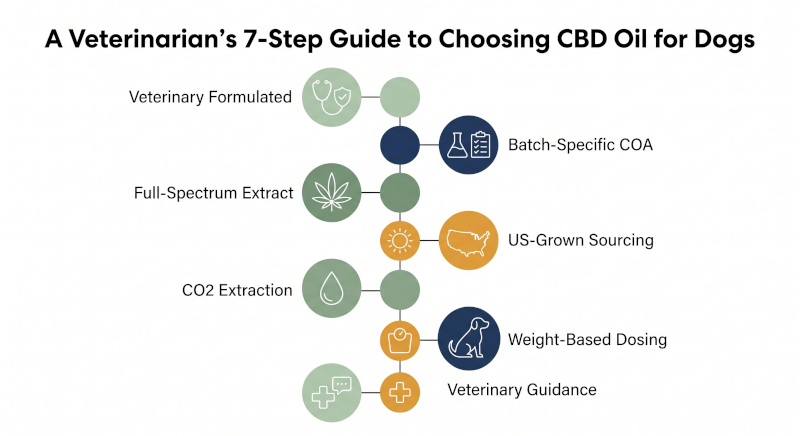
You do not need to memorize the chemistry to evaluate a brand. Run any product you are considering through these seven questions, in order. A good CBD oil for dogs answers all of them without making you dig.
The Seven Questions, in Order
Criterion |
The Question to Ask |
|---|---|
| 1. Veterinary formulation | Who formulated it, and what are their veterinary or scientific credentials? |
| 2. Certificate of Analysis | Is there a batch-specific COA from an ISO 17025 accredited lab? |
| 3. Spectrum | Is it full-spectrum (or broad-spectrum), rather than isolate? |
| 4. Hemp source | Is the hemp US-grown under a regulated program, with origin stated? |
| 5. Extraction | Is it CO2-extracted and solvent-free? |
| 6. Potency and dosing | Is there clear, weight-based dosing guidance and a stated concentration? |
| 7. Veterinary guidance | Have you talked with your own vet, especially about other medications? |
9. How Peak Therapeutics Meets These Criteria
Peak Therapeutics was founded on the principle that a veterinary wellness product should be held to the same evidence standards as any other clinical tool. Measured against the seven criteria above, here is how our full-spectrum CBD oil for dogs is built.
How Peak Therapeutics Approaches Each Criterion
Criterion |
How Peak Therapeutics Approaches It |
|---|---|
| Veterinary formulation | Formulated by Dr. James S. Gaynor, DACVAA, a board-certified veterinary anesthesiologist, and recommended in his own practice. |
| Certificate of Analysis | Batch-specific COAs from an ISO 17025 accredited laboratory, published online for every batch. |
| Full-spectrum | Full-spectrum hemp extract, chosen to preserve the entourage effect rather than isolating a single compound. |
| Hemp source | Proprietary Colorado-grown hemp, vertically integrated from seed to finished product. |
| Extraction | CO2 extraction: clean, solvent-free, and profile-preserving. |
| Dosing | Detailed, weight-based dosing guidance written for dogs at canine-appropriate concentrations. |
In 2025, a pharmacokinetic study funded by Peak Therapeutics and published in Frontiers in Veterinary Science examined the bioavailability and safety profile of full-spectrum CBD in dogs, adding further scientific grounding to our formulations.
10. A Brief History: Cannabinoids in Veterinary Medicine
CBD may feel like a recent arrival, but cannabis has a documented relationship with animal medicine that long predates modern pharmacology. A short timeline provides useful context for why cannabinoid wellness has attracted renewed scientific interest.
A Short Timeline
Era |
Milestone |
|---|---|
| 1800s | Cannabis tinctures were a standard part of the Western veterinary pharmacopeia, used in horses and livestock. |
| 1990s | The CB1 (1990) and CB2 (1993) receptors were identified and the endocannabinoid system characterized, explaining why cannabis preparations produced the effects clinicians had long observed. |
| 2018 | The U.S. Agriculture Improvement Act (Farm Bill) removed hemp from the Controlled Substances Act, enabling research and commercial development of veterinary-grade hemp products. |
| 2018 | A Cornell University study (Gamble et al.) reported pharmacokinetics, safety, and comfort and mobility findings for CBD oil in dogs, among the first controlled canine CBD trials. |
| 2021 | Cannabis Therapy in Veterinary Medicine: A Complete Guide (Springer), co-edited by Dr. Gaynor, was published, the first comprehensive peer-reviewed academic text on veterinary cannabinoid medicine. |
| Present | Canine cannabinoid research continues to expand, refining how veterinarians evaluate and recommend full-spectrum hemp products. |
11. Frequently Asked Questions
Each answer below opens with a direct, self-contained response, followed by context.
How do I choose the best CBD oil for my dog?
Start with who formulated it. The most reliable signal of a quality CBD oil is whether a credentialed veterinarian or scientist formulated it, because that reflects an understanding of canine physiology a marketing team cannot replicate. From there, confirm a batch-specific Certificate of Analysis from an ISO 17025 accredited lab, choose full-spectrum hemp from a clearly stated US source, verify CO2 extraction, match potency to your dog’s weight, and talk with your own veterinarian before starting.
What is the single most important thing to look for in a dog CBD oil?
Two things matter most, in order: veterinary formulation and a third-party Certificate of Analysis. A product formulated by a credentialed veterinarian, with a batch-specific COA from an ISO 17025 lab, clears the two highest bars at once. The COA tells you whether the product contains what the label claims, verifies THC compliance, and screens for contaminants. Veterinary formulation tells you a qualified clinician designed it specifically for dogs.
How do I read a CBD Certificate of Analysis?
Check four things: that the measured CBD potency matches the label, that THC is below 0.3%, that the contaminant panels (pesticides, heavy metals, microbials) pass, and that the certificate’s batch number matches the lot on your bottle. The issuing laboratory should hold ISO 17025 accreditation. A generic certificate that does not match your specific batch is a red flag worth taking seriously.
Is full-spectrum CBD better than isolate for dogs?
Most veterinary and research perspectives favor full-spectrum hemp extract for dogs, because of the entourage effect, where cannabinoids and terpenes appear to work together more effectively than CBD alone. Broad-spectrum is a reasonable THC-free alternative; isolate is the simplest form but lacks the supporting plant compounds that contribute to whole-plant wellness support.
How much CBD oil should I give my dog?
CBD dosing for dogs is weight-based. A common, conservative starting range is about 0.25 to 0.5 mg of CBD per pound of body weight, given with food, then adjusted gradually based on your dog’s response. Follow the product’s weight-based label guidance and your veterinarian’s advice, especially if your dog takes other medications. Read the concentration in mg per mL, not just the total on the bottle.
How long does CBD oil take to work in dogs?
Given orally, CBD oil typically begins absorbing within 30 to 60 minutes. For ongoing wellness support, consistent daily use over two to four weeks often produces more noticeable cumulative effects. For a predictable event, many owners give a dose 30 to 60 minutes ahead so it is on board when it is needed.
Can I give my dog too much CBD?
At very high doses, CBD can cause mild sedation or gastrointestinal upset in dogs, which is why starting at the low end of the recommended range and adjusting gradually is always the right approach. Hemp-derived CBD kept below 0.3% THC is non-intoxicating, and reported effects are usually mild and transient.
Is CBD oil safe for dogs?
Hemp-derived CBD kept below 0.3% THC is non-intoxicating and generally well tolerated in dogs at sensible doses, with mild, transient effects being the most commonly reported. Because CBD can influence the cytochrome P450 enzymes that metabolize many medications, coordinate with your veterinarian, particularly for dogs on other drugs, and consider periodic liver-value checks for long-term use.
Why does veterinary formulation matter more than the brand name?
Because a veterinarian who formulates CBD for dogs brings knowledge of canine physiology, clinical experience with how dogs respond to cannabinoids, and professional accountability, none of which a brand name alone guarantees. Ask any brand who formulated the product and what their veterinary or scientific background is. If they cannot answer specifically, that itself is informative.
Is CBD legal for dogs?
Yes. Hemp-derived CBD products with THC below 0.3% are federally legal under the 2018 Farm Bill, and are legal in states including Colorado. State and local rules can still vary, so it is worth confirming the regulations where you live.
Explore Peak Therapeutics Full-Spectrum CBD Oil for Dogs
Veterinarian-formulated. Full-spectrum Colorado-grown hemp. CO2-extracted. Lab-tested with a Certificate of Analysis for every batch.
12. References
Gamble L-J, Boesch JM, Frye CW, et al. Pharmacokinetics, Safety, and Clinical Efficacy of Cannabidiol Treatment in Osteoarthritic Dogs. Front Vet Sci. 2018;5:165. doi:10.3389/fvets.2018.00165
Wakshlag JJ, Cital S, Eaton SJ, Prussin R, Hudalla C. Cannabinoid, Terpene, and Heavy Metal Analysis of 29 Over-the-Counter Commercial Veterinary Hemp Supplements. Vet Med (Auckl). 2020;11:45–55. doi:10.2147/VMRR.S248712
Di Salvo A, Conti MB, Della Rocca G. Pharmacokinetics, efficacy, and safety of cannabidiol in dogs: an update of current knowledge. Front Vet Sci. 2023;10:1204526. doi:10.3389/fvets.2023.1204526
Bonn-Miller MO, Loflin MJE, Thomas BF, et al. Labeling Accuracy of Cannabidiol Extracts Sold Online. JAMA. 2017;318(17):1708–1709. doi:10.1001/jama.2017.11909
Silver RJ. The Endocannabinoid System of Animals. Animals (Basel). 2019;9(9):686. doi:10.3390/ani9090686
Peak Therapeutics-funded pharmacokinetic study of full-spectrum CBD in dogs. Front Vet Sci. 2025;12:1556975. Read the study
Cital S, Kramer K, Hughston L, Gaynor JS (eds). Cannabis Therapy in Veterinary Medicine: A Complete Guide. Springer, 2021.
Gaynor JS, Muir WW (eds). Handbook of Veterinary Pain Management, 3rd Edition. Mosby/Elsevier, 2015.
13. About Dr. James S. Gaynor, DVM, MS, DACVAA
 Dr. James S. Gaynor is a board-certified veterinary specialist in anesthesia and pain management, a Diplomate of the American College of Veterinary Anesthesiologists, and Chief Medical Officer of Peak Therapeutics. He co-edited Cannabis Therapy in Veterinary Medicine: A Complete Guide (Springer, 2021), the first comprehensive peer-reviewed academic textbook on veterinary cannabinoid medicine, and has more than three decades of clinical and academic experience.
Education
- BA, Biology, The Colorado College, Colorado Springs, CO, 1983
- DVM, The Ohio State University, Columbus, OH, 1988
- Anesthesiology Residency and MS (Cardiac Physiology), The Ohio State University, Columbus, OH, 1992
Board Certifications and Credentials
- Diplomate, American College of Veterinary Anesthesiologists (DACVAA), 1993
- Board Certified, Academy of Integrative Pain Management, 2004
- Certified, International Veterinary Acupuncture Society, 1999
- Certified Veterinary Pain Practitioner, International Veterinary Academy of Pain Management, 2011
- Certified CBD Consultant, Cannabinoid Medicine Studies, 2020
Academic and Clinical Career
- Assistant/Associate Professor and Section Head of Anesthesiology, Colorado State University College of Veterinary Medicine, 1992–2003
- Medical Director and Staff Anesthesiologist, Peak Performance Veterinary Group, Frisco, CO, 2004–2021
- Medical Director and Staff Anesthesiologist, Colorado Animal Specialty and Emergency, Boulder, CO, 2021–2026
- Staff Anesthesiologist, Buffalo Mountain Animal Hospital, Dillon, CO, 2026–present
- Medical Director and Staff Anesthesiologist, Black Dog Veterinary Anesthesia Services, Breckenridge, CO, 2026–present
- Associate Editor, Frontiers in Veterinary Sciences, 2025–present
Published Books
- Cannabis Therapy in Veterinary Medicine: A Complete Guide, Co-editor and Author (Springer, 2021), the definitive peer-reviewed academic textbook on veterinary cannabinoid medicine across species.
- Handbook of Veterinary Pain Management, 3rd Edition, Lead Editor and Author (Mosby/Elsevier, 2015), the gold-standard clinical reference for veterinary pain management practitioners.
© 2026 Peak Therapeutics | Authored by Dr. James S. Gaynor, DVM, MS, DACVAA | peaktherapeutics.net
This article is for educational and informational purposes only and does not constitute veterinary medical advice. It does not describe the diagnosis, treatment, cure, or prevention of any disease.
Consult a licensed veterinarian before starting any cannabinoid or wellness protocol for your dog. All products contain less than 0.3% THC by weight.
Recent Comments