

Veterinary guide to hyaluronic acid (HA) for dogs: why high-molecular-weight HA (HMW-HA) supports joints — and why low-molecular-weight HA can make joint disease worse.
Covers synovial fluid viscosity, cartilage protection, the hyaluronidase mechanism, oral HMW-HA pharmacokinetics in dogs, dosing, and integration into a multimodal canine joint wellness protocol.
In This Article
- What Is Hyaluronic Acid for Dogs? The Biology of Synovial Fluid and Cartilage
- Why Molecular Weight Is Everything: HMW-HA vs. LMW-HA in the Canine Joint
- The Hyaluronidase Problem: How Low-Molecular-Weight HA Can Make Joint Disease Worse
- How Hyaluronic Acid Supports Canine Joint Health: Mechanism of Action
- Featured Research: Oral HMW-HA Absorption and Tissue Distribution in Dogs
- Clinical Evidence for Oral Hyaluronic Acid in Canine Osteoarthritis
- Beyond Joints: Hyaluronic Acid for Skin, Coat, Eyes, and Wound Healing in Dogs
- Hyaluronic Acid Dosage for Dogs: What the Evidence Does and Does Not Tell Us
- Integrating Hyaluronic Acid into a Multimodal Canine Joint Wellness Protocol
- The Peak Therapeutics Hyaflex Line: Hyalogic-Manufactured, Veterinarian-Selected
- Frequently Asked Questions — Hyaluronic Acid for Dogs
- References
- About Dr. James S. Gaynor, DVM, MS, DACVAA
Key Takeaways: Hyaluronic Acid for Dogs
- Molecular weight is the single most important variable in oral HA supplementation. High-molecular-weight HA (HMW-HA, >1,000 kDa) is anti-inflammatory and tissue-protective; low-molecular-weight HA fragments are pro-inflammatory and act as endogenous danger signals at the joint.
- HMW-HA suppresses hyaluronidase and aggrecanase activity in cartilage. LMW-HA fragments do the opposite — they induce non-specific hyaluronidase activity that degrades the dog’s own native HMW-HA, reducing synovial fluid viscosity and accelerating cartilage breakdown.
- Oral HMW-HA is absorbed and reaches joint tissue in dogs. Balogh et al. (2008) demonstrated that orally administered HMW-HA reaches joints, vertebrae, and connective tissues in Beagles, with approximately 13.3% of the oral dose distributing to connective tissue.
- Clinical benefit has been demonstrated in canine post-surgical joint protocols. Serra Aguado et al. (2021) reported improved osteoarthritis biomarkers in dogs receiving oral HA after TTA surgery for cranial cruciate ligament rupture.
- High-molecular-weight HA is non-negotiable for joint applications. Inexpensive HA supplements often contain fragmented, lower-molecular-weight material that may actively work against the joint it is being given to support.
What Is Hyaluronic Acid for Dogs?
Quick Answer: Hyaluronic acid for dogs is a joint supplement that replenishes the same gel-like, lubricating molecule found naturally in canine synovial fluid and cartilage. The high-molecular-weight form (HMW-HA, >1,000 kDa) supports joint comfort, mobility, and cartilage protection in dogs with arthritis, post-surgical joints, age-related stiffness, or dog joint pain. However, the low-molecular-weight (LMW-HA) form can actively worsen joint inflammation. For senior dog joint health or any canine joint supplement decision, molecular weight — not total milligrams — is what determines whether HA helps or harms.
Why Molecular Weight, Not Milligrams, Determines Whether HA Helps or Harms
Few joint supplements for dogs in canine medicine are as widely used — and as inconsistently formulated — as hyaluronic acid for dogs (often abbreviated HA for dogs). HA is the dominant lubricating molecule in synovial fluid, a primary structural element of articular cartilage, and the most directly relevant single molecule for joint comfort, mobility, and the management of dog joint pain. In fact, the biological case for supplementing it in dogs with osteoarthritis, post-surgical recovery, or age-related mobility loss is compelling. However, there is a clinically critical detail that almost every consumer-facing source overlooks: molecular weight matters far more than total milligrams.
This guide is written for both veterinarians and the dog owners they advise. Specifically, I cover the biology of canine HA, how molecular weight determines whether oral HA helps or harms the joint, the published evidence on oral HMW-HA absorption and clinical effect in dogs, practical considerations for selecting and dosing a canine HA joint supplement, and how HMW-HA fits into a multimodal joint wellness protocol for senior dog joint health and active-dog support alike. Notably, all content reflects the same evidence standards I have applied throughout my academic career at Colorado State University and three decades of clinical practice in veterinary anesthesia and pain management.
1. What Is Hyaluronic Acid for Dogs? The Biology of Synovial Fluid and Cartilage
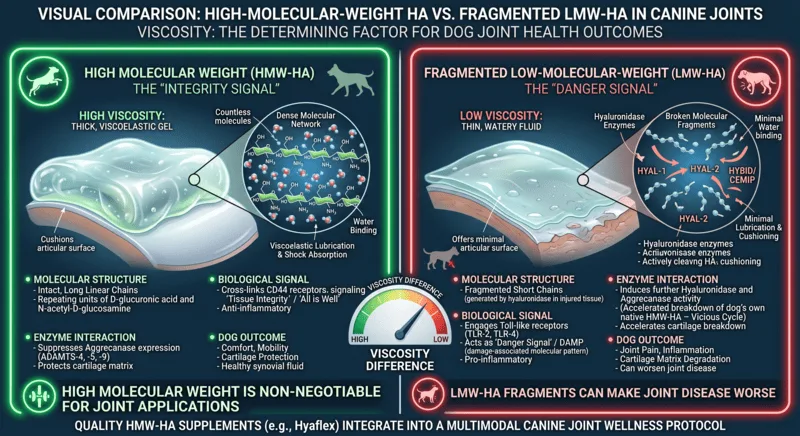 Hyaluronic acid (HA) — also called hyaluronan or sodium hyaluronate — is a linear glycosaminoglycan composed of repeating units of D-glucuronic acid and N-acetyl-D-glucosamine. In a healthy dog, HA is synthesized continuously by hyaluronan synthases (HAS1, HAS2, HAS3) in synovial cells, chondrocytes, fibroblasts, and skin keratinocytes. It is among the most hydrophilic molecules in biology: a single HA chain can bind up to a thousand times its own weight in water, which is what gives synovial fluid its characteristic gel-like, shock-absorbing texture.
In a healthy canine joint, HA is present at 1,400–3,600 µg per gram of synovial fluid — by far the most concentrated site of HA in the body. There, HA performs three jobs simultaneously: it lubricates the cartilage surfaces against each other, it cushions impact during weight-bearing and locomotion, and it organizes the proteoglycan-rich extracellular matrix of articular cartilage. Similarly, in skin, HA hydrates the dermis and supports collagen scaffolding. In the eye, it is the major structural component of the vitreous humor. In other words, the same molecule, with the same chemistry, does different jobs across tissues.
With age, repeated joint loading, traumatic injury, and chronic inflammation, two things happen together: the dog’s synthesis of new HA declines, and the existing HA pool is degraded faster than it can be replaced. As a result, the net result is a synovial fluid that contains less HA, of lower average molecular weight, with reduced viscosity and elasticity. Consequently, the joint becomes mechanically less efficient and biochemically more inflammatory at the same time — and this is the substrate on which clinical osteoarthritis develops.
Tissue |
HA Concentration and Functional Role in Dogs |
|---|---|
| Synovial fluid | 1,400–3,600 µg/g. The highest concentration in the body. HMW-HA provides viscoelastic lubrication and shock absorption. Reduced concentration and molecular weight are hallmarks of canine osteoarthritis. |
| Articular cartilage | Integral to the proteoglycan-aggrecan network. HMW-HA anchors aggrecan monomers to form the macromolecular structure that resists compression. Loss of HA equals loss of cartilage mechanical integrity. |
| Skin (dermis) | Approximately 500 µg/g. Maintains hydration, supports collagen scaffolding, contributes to elasticity and barrier function. Declines with age, contributing to dry, less elastic skin in senior dogs. |
| Vitreous humor (eye) | Approximately 200 µg/g. Primary structural component. Supports retinal positioning and ocular hydration. |
| Tendons and ligaments | Present in the extracellular matrix; supports tissue gliding and connective tissue hydration. Relevant in canine working and sporting dogs subject to repetitive musculoskeletal loading. |
2. Why Molecular Weight Is Everything: HMW-HA vs. LMW-HA in the Canine Joint
If there is one section of this guide that I want every horse and dog owner — and every veterinary professional — to internalize, it is this one. Hyaluronic acid is not a single molecule. Indeed, it is a family of molecules with the same chemistry but vastly different biological behaviors depending on chain length (molecular weight). Above all, in the joint, those behaviors can be diametrically opposed.
By convention in the molecular biology literature, three size classes are recognized:
HA Size Class |
Molecular Weight and Biological Behavior |
|---|---|
| High-Molecular-Weight HA (HMW-HA) | Greater than approximately 1,000 kDa (typically 1–6 million Da). This is the form found in healthy, uninjured tissue — the form the dog’s own body produces. HMW-HA is anti-inflammatory, viscoelastic, and tissue-protective. It cross-links the CD44 receptor on chondrocytes and synoviocytes in a way that communicates a ’tissue integrity’ signal — telling the immune system that all is well and inflammation should resolve. |
| Low-Molecular-Weight HA (LMW-HA) | Approximately 80–800 kDa. This is the form that accumulates in injured and inflamed tissues. LMW-HA is generated when hyaluronidase enzymes (HYAL-1, HYAL-2, and the more recently characterized HYBID/CEMIP) cleave native HMW-HA into fragments. LMW-HA does not cross-link CD44 the same way. Instead it engages Toll-like receptors TLR-2 and TLR-4 and acts as a ‘danger signal’ — a damage-associated molecular pattern (DAMP) that actively recruits inflammation. |
| HA Oligosaccharides (oligo-HA) | Less than approximately 6 kDa (a few disaccharide units). The smallest, most pro-inflammatory class. These short fragments are potent TLR agonists, induce pro-inflammatory cytokines including IL-1β, IL-6, IL-8 and TNF-α through NF-κB signaling, and upregulate matrix metalloproteinases (MMPs) and aggrecanases (ADAMTS-4, ADAMTS-5) — the very enzymes that break down cartilage. |
The clinical implication is direct and consequential. A bottle labeled ‘hyaluronic acid for dogs’ tells you nothing about whether the product will help or harm the joint. For example, a high-molecular-weight HA product mimics what the healthy canine joint naturally produces and reinforces the anti-inflammatory, tissue-integrity signal. On the other hand, a low-molecular-weight or fragmented HA product mimics what the diseased joint is already producing too much of — and may add to the very inflammatory cascade the owner is trying to interrupt.
3. The Hyaluronidase Problem: How Low-Molecular-Weight HA Can Make Joint Disease Worse
This is the most clinically important — and least appreciated — mechanism in oral HA supplementation, and it is the reason that, in my practice, I will not recommend an HA product unless I know its molecular weight is high. Specifically, the mechanism involves hyaluronidase, the family of enzymes that degrade hyaluronic acid in tissue.
Hyaluronidase: A Non-Specific Enzyme
Hyaluronidases in canine joint tissue — including HYAL-1, HYAL-2, and HYBID/CEMIP — do not discriminate between the dog’s own native HMW-HA and exogenous HA introduced from a supplement or injection. Put simply, they are non-specific: they cleave HA chains regardless of source. In osteoarthritic canine cartilage, expression of HYBID is markedly elevated above normal cartilage levels, contributing to accelerated breakdown of the joint’s own HMW-HA. For this reason, this baseline elevation of hyaluronidase activity is part of why OA is a self-perpetuating disease.
The Vicious Cycle Driven by LMW-HA
Here is the feedback loop that matters for any veterinarian or owner choosing a canine HA supplement:
- LMW-HA fragments engage TLR-2 and TLR-4 on synoviocytes, chondrocytes, and infiltrating macrophages.
- TLR engagement activates NF-κB and MAPK signaling, driving transcription of pro-inflammatory cytokines (IL-1β, IL-6, TNF-α) and chemokines (IL-8, MCP-1).
- These cytokines, particularly IL-1β, upregulate further hyaluronidase expression (including HYBID) and aggrecanase expression (ADAMTS-4, ADAMTS-5).
- More hyaluronidase activity means more cleavage of the joint’s own native HMW-HA into still more LMW-HA fragments — which feed back into step one.
- Synovial fluid viscosity drops. Cartilage matrix degrades. Joint pain increases. The dog feels worse.
Critically, hyaluronidase is non-specific. Once it is upregulated by LMW-HA signaling, it does not selectively degrade only the supplemental LMW-HA — it degrades the dog’s endogenous HMW-HA as well. Therefore, a low-molecular-weight HA supplement, by inducing hyaluronidase activity, can reduce the total amount of joint-lubricating high-molecular-weight HA the dog has available. In short, the joint ends up with less of the molecule that lubricates it, not more.
Conversely, HMW-HA has been shown in cartilage and synoviocyte models to inhibit cytokine-induced aggrecanase expression (specifically ADAMTS-4, ADAMTS-5, and ADAMTS-9) and to protect cartilage from matrix degradation in a molecular size-dependent manner (Yatabe et al., 2018). Furthermore, in synovial fibroblast studies, inhibition of hyaluronidase activity (HYAL-1, HYAL-2, HYAL-3) reduces TLR-4 and CD44 activation by HA fragments and downstream inflammatory mediator production. To that end, the takeaway is clear: providing HMW-HA, and avoiding the introduction of LMW-HA fragments, are two sides of the same therapeutic strategy.
“Molecular weight is not a marketing detail — it is the therapeutic mechanism. If a hyaluronic acid product for dogs introduces low-molecular-weight HA into a joint, it can induce non-specific hyaluronidase activity that degrades the dog’s own native high-molecular-weight HA. The joint ends up with less lubrication, not more. This is why I only recommend high-molecular-weight HA supplements for canine joint support.”
— Dr. James S. Gaynor, DACVAA — Board-Certified Veterinary Specialist in Anesthesia & Pain Management
4. How Hyaluronic Acid Supports Canine Joint Health: Mechanism of Action
Building on the molecular-weight framework above, the clinical benefits of high-molecular-weight hyaluronic acid for dogs can be traced to several convergent mechanisms — all of which depend on the supplemented HA actually being high molecular weight.
Mechanism |
Clinical Relevance in Dogs |
|---|---|
| Viscosupplementation | HMW-HA restores synovial fluid viscoelasticity. Higher-MW HA produces synovial fluid that is meaningfully more viscous and elastic than lower-MW HA, improving lubrication of articulating cartilage surfaces and reducing friction-driven cartilage wear. |
| CD44 cross-linking (tissue integrity signal) | HMW-HA cross-links CD44 receptors on chondrocytes and synoviocytes in a configuration that communicates ‘intact, healthy tissue’ to the immune system — promoting resolution of inflammation rather than its amplification. LMW-HA does not produce this signal. |
| Suppression of aggrecanase expression | HMW-HA has been shown to inhibit cytokine-induced expression of ADAMTS-4, ADAMTS-5, and ADAMTS-9 in chondrocytes — the principal aggrecanases responsible for proteoglycan degradation in canine OA. This is a structural, cartilage-protective mechanism. |
| Reduction in TLR-driven inflammation | By displacing LMW-HA fragments and restoring the HMW/LMW ratio toward normal, HMW-HA reduces TLR-2 and TLR-4 activation, NF-κB signaling, and downstream production of IL-1β, IL-6, TNF-α, and MMPs. |
| Anti-inflammatory eicosanoid modulation | Oral HA has been shown to reduce PGE2 production in synovial cell models. Through TLR-4-dependent pathways in the gut, oral HA can also enhance IL-10 (anti-inflammatory cytokine) production — a mechanism distinct from intra-articular HA but clinically relevant for oral supplementation. |
| Chondrocyte and cartilage matrix support | HMW-HA supports the normal proteoglycan-aggrecan-HA macromolecular network in articular cartilage, maintaining the structural integrity that resists compressive load during weight-bearing. |
5. Featured Research: Oral HMW-HA Absorption and Tissue Distribution in Dogs
The most directly relevant peer-reviewed study supporting oral hyaluronic acid for dogs is Balogh et al. (2008), which used radiolabeled HMW-HA to track absorption, tissue distribution, and excretion in Beagle dogs and Wistar rats. In particular, this study is the foundation of the biological plausibility argument for oral canine HA: it directly answers the most common skeptical question — ‘does the HA actually get to the joint?’
Featured Research: Oral HMW-HA in Dogs
Study: Balogh L, Polyak A, Mathe D, Kiraly R, Thuroczy J, Terez M, Janoki G, Ting Y, Bucci LR, Schauss AG. Absorption, uptake and tissue affinity of high-molecular-weight hyaluronan after oral administration in rats and dogs. J Agric Food Chem. 2008;56(22):10582–10593. doi:10.1021/jf8017029
Design: Single-dose oral administration of 99mTc-labeled high-molecular-weight hyaluronan (approximately 1,000 kDa) to Beagle dogs and Wistar rats. A 99mTc-pertechnetate control group was used to confirm that observed tissue uptake reflected intact HA rather than free label. Whole-body scintigraphy, organ-level radioactivity counting, and NanoSPECT/CT imaging tracked tissue distribution over 48 hours.
Key findings: Orally administered HMW-HA was absorbed from the gastrointestinal tract, with approximately 13.3% of the oral dose distributed to connective tissues. Scintigraphic imaging of the dogs’ ventral chest region demonstrated specific concentration of label in joints, vertebrae, and salivary glands within four hours of dosing, with persistence through 48 hours. Importantly, the tissue distribution pattern was clearly different from the 99mTc-pertechnetate control, confirming that intact HA — not just the radiolabel — was reaching joint and connective tissue.
Implication: Oral HMW-HA is biologically available to canine joint tissue. Moreover, this is the foundational pharmacokinetic finding that underpins all subsequent clinical use of oral HA in dogs.
Limitation: This is a pharmacokinetic and tissue-distribution study, not a clinical efficacy trial. It demonstrates that HA gets to the joint — not how much clinical improvement that delivers. The clinical evidence base is covered in the next section.
6. Clinical Evidence for Oral Hyaluronic Acid in Canine Osteoarthritis
Beyond the Balogh pharmacokinetic foundation, the peer-reviewed clinical evidence base for oral HA in dogs is growing but remains smaller than the evidence base for, say, omega-3 fatty acids. For this reason, veterinarians making evidence-based decisions about hyaluronic acid for dogs should be aware of both the strongest available study and the gaps that remain.
Serra Aguado et al. (2021) — Effects of Oral Hyaluronic Acid Administration in Dogs Following Tibial Tuberosity Advancement Surgery for Cranial Cruciate Ligament Injury
This study evaluated oral HA in dogs following tibial tuberosity advancement (TTA) surgery for cranial cruciate ligament (CCL) rupture — a clinically common scenario in which post-surgical joint inflammation and progressive osteoarthritis are both significant concerns. Dogs were randomized to receive either oral HA or placebo for ten weeks following surgery, with biomarker assessment of inflammation and joint metabolism.
The HA preparation used was a rooster-comb–derived oral HA capsule containing 27 mg HA per capsule, dosed by body weight: dogs up to 26 kg received one capsule daily (~1 mg/kg/day in a 25 kg dog), and dogs above 26 kg received two capsules daily (~1.3 mg/kg/day in a 40 kg dog). Notably, the supplemented group demonstrated improved post-surgical biomarker profiles compared to placebo, supporting the clinical rationale for oral HA as part of post-surgical joint protocols in dogs recovering from orthopedic procedures.
In my own practice, the post-orthopedic-surgery window — when the joint is at the highest risk of accelerated osteoarthritis development — is one of the clearest indications for adding a quality oral HMW-HA supplement to the multimodal protocol.
What the Evidence Base Does Not Yet Resolve
Veterinarians and owners should know that the peer-reviewed canine HA literature does not yet include the same depth of large, multi-center RCTs that exists for omega-3 fatty acids in canine osteoarthritis. Instead, the directly applicable canine clinical evidence consists of one well-designed post-surgical study, plus extrapolation from intra-articular HA studies, equine oral HA studies, the canine pharmacokinetic data (Balogh), and a broad and mechanistically robust extracellular matrix literature in chondrocytes, synoviocytes, and immune cells across species.
Given this evidence landscape, my clinical position is that oral HMW-HA is biologically rational, pharmacokinetically supported, and clinically reasonable as part of a multimodal canine joint wellness protocol — particularly in senior dogs, post-surgical dogs, working and performance dogs, and dogs with confirmed osteoarthritis where the goal is to reduce cumulative NSAID exposure. Likewise, as with any nutraceutical, response should be individually assessed at 8–12 weeks and dose adjusted accordingly.
7. Beyond Joints: Hyaluronic Acid for Skin, Coat, Eyes, and Wound Healing in Dogs
While the joint indication is the most clinically prominent application of hyaluronic acid for dogs, HA’s distribution across canine tissues means the supplementation logic extends to several other systems. Additionally, the same molecular-weight principle applies: HMW-HA supports tissue integrity, LMW-HA fragments contribute to inflammation.
Indication |
Role of HMW-HA in Dogs |
|---|---|
| Skin and coat health | HMW-HA in the dermis maintains hydration, supports collagen scaffolding, and contributes to skin elasticity and barrier function. Owners commonly observe improved coat shine and reduced dry/flaky skin with consistent oral HMW-HA supplementation, particularly in senior dogs whose endogenous HA production has declined. |
| Wound healing and tissue repair | HA is among the first molecules upregulated in the early phase of canine wound healing. It creates a moist, organized matrix in which fibroblasts migrate, blood vessels grow (angiogenesis), and tissue remodels. Both oral and topical HA have been shown to accelerate wound closure in animal models. |
| Ocular health | HMW-HA is a major structural component of the canine vitreous humor and contributes to tear film stability. Oral HA may have supportive value in dogs with keratoconjunctivitis sicca (dry eye) as part of an integrated ophthalmology plan; topical HA ophthalmic preparations are commonly used as artificial tear adjuncts. |
| Connective tissue and tendons | HA is present throughout tendon, ligament, and fascia. In canine athletes and working dogs subject to repetitive musculoskeletal loading, HMW-HA supplementation supports connective tissue hydration and may complement structural joint support and physical conditioning. |
| Senior dog wellness | Senior dogs typically present with reduced endogenous HA across multiple tissues: thinner, drier skin; less viscous synovial fluid; reduced tear film. HMW-HA supplementation addresses several of these in parallel — a single, well-tolerated intervention with multi-system relevance. Foundational in my senior wellness protocols. |
8. Hyaluronic Acid Dosage for Dogs: What the Evidence Does and Does Not Tell Us
I want to be direct with veterinarians and dog owners about what we do and don’t know on canine HA dosing. Unlike omega-3 fatty acids — where multiple RCTs have established defensible per-kilogram targets — the canine HA literature is product-specific and limited. There is no universally accepted, evidence-based mg/kg target for oral hyaluronic acid in dogs. That said, what we have is:
- A peer-reviewed clinical regimen: Serra Aguado et al. (2021) used a rooster-comb–derived HA capsule (27 mg HA per capsule), dosed at 1 capsule daily for dogs up to 26 kg and 2 capsules daily for dogs above 26 kg. In a 25 kg dog this corresponds to approximately 1 mg/kg/day; in a 40 kg dog approximately 1.3 mg/kg/day.
- Commercial product practice: Most commercial canine HMW-HA products — including the Hyalogic Hyaflex line that Peak Therapeutics markets to its clinical clients — follow a fixed-volume-per-weight-band approach (typically delivering roughly 1–2 mg of HA per day for small dogs, scaling up for larger dogs). These are manufacturer-formulated dosing schedules, not population-level evidence-based targets.
- Pharmacokinetic context: Balogh et al. (2008) confirmed that orally administered HMW-HA reaches the joint, with approximately 13% of the dose distributing to connective tissue.
A Practical Clinical Framework
Given the limitations of the published mg/kg evidence, the most defensible practical approach for hyaluronic acid dosage for dogs is to follow the manufacturer’s body-weight–based dosing on a high-quality high-molecular-weight HA product, give it consistently with food for at least 8–12 weeks, and assess clinical response. Ultimately, the following ranges are derived from the published study regimen and commonly used commercial product doses, and should be considered conservative starting points rather than rigid prescriptions:
Body Weight |
Practical Starting Range (Oral HMW-HA) |
|---|---|
| Small dogs (5–30 lbs) | Approximately 1–2 mg HMW-HA daily, with food. Many commercial liquid formulations deliver this in a fraction of a standard dropper. |
| Medium dogs (31–75 lbs) | Approximately 2 mg HMW-HA daily, with food. This bracket aligns with the lower end of the Serra Aguado et al. (2021) per-kg exposure range. |
| Large dogs (75+ lbs) | Approximately 2–4 mg HMW-HA daily, with food. The Serra Aguado study used 54 mg/day of capsule HA in dogs over 26 kg; liquid HMW-HA products typically dose 2 mg/day in this weight category. Higher doses can be considered under veterinary guidance, particularly post-surgically. |
| Post-surgical or active OA cases | May benefit from the higher end of the body-weight dose range (and, in some clinical regimens, doses approaching the 50 mg/day range used in the Serra Aguado study), and from layering HA with structural joint support (glucosamine, chondroitin), omega-3 fatty acids, and CBD-based ECS support. Discuss with your veterinarian. |
Practical Administration Considerations
✔ Give with food. Although oral HMW-HA is absorbed without a specific lipid co-factor, mixing into food improves consistency of administration and palatability. Moreover, once-daily dosing is sufficient based on the available pharmacokinetic data.
✔ Be patient — allow 8–12 weeks. Joint matrix and synovial fluid remodeling are slow processes. Therefore, owners should be counseled to expect onset of clinical benefit over weeks rather than days, and to maintain consistent daily administration during the assessment window. That said, some dogs may respond within 5–14 days.
✔ Verify molecular weight before purchasing. A reputable canine HA product will state that it is high-molecular-weight. If the label does not specify, or the price seems implausibly low, assume the product may be fragmented or lower-molecular-weight material that could be working against the joint.
✔ Monitor in dogs on blood thinners or with clotting disorders. HA is generally very well tolerated, but oral supplementation in dogs on anticoagulant therapy or with known coagulopathies should be discussed with the prescribing veterinarian.
✔ Watch for mild GI signs. The most common adverse effect is transient loose stool or mild GI upset, usually self-limiting. Reduce dose temporarily, then increase gradually as tolerated.
9. Integrating Hyaluronic Acid into a Multimodal Canine Joint Wellness Protocol
Hyaluronic acid for dogs is, in my clinical view, a foundational but not standalone intervention. Like every other nutraceutical I have written about for Peak Therapeutics — omega-3 fatty acids, CBD, glucosamine and chondroitin — HMW-HA produces its best clinical outcomes as one component of a multimodal protocol that addresses the joint through multiple independent biological pathways.
Protocol Component |
Role in Multimodal Canine Joint Wellness |
|---|---|
| High-Molecular-Weight HA (Hyaflex) | Restores synovial fluid viscoelasticity. Cross-links CD44 in a tissue-integrity signal. Suppresses aggrecanase expression and reduces hyaluronidase-driven inflammatory cascade. Direct lubrication and matrix support. |
| Glucosamine and chondroitin | Cartilage matrix building blocks. Support proteoglycan synthesis and protect existing matrix from enzymatic breakdown. Complementary mechanism to HA — different substrate level. |
| Omega-3 fatty acids (EPA and DHA) | Shift the fatty acid substrate pool away from pro-inflammatory eicosanoids toward specialized pro-resolving mediators (resolvins, protectins, maresins). Biomarker-verifiable via Omega-3 Index and iFATS. The most evidence-supported nutraceutical for canine OA. See Peak Therapeutics VRS TruBenefits Omega Canine for the EPA/DHA component of a multimodal joint protocol. |
| CBD / full-spectrum hemp | Engages the endocannabinoid system at the receptor level — modulating nociceptive signaling, inflammatory cytokine release, and stress associated with chronic discomfort. Different mechanism, complementary effect. See the Peak Therapeutics CBD for Pets line for the ECS component. |
| NSAIDs (where clinically indicated) | Veterinarian-prescribed NSAIDs remain a cornerstone of canine OA management. A consistent finding in clinical practice is that effective nutraceutical layering (HA + omega-3 + CBD + structural support) reduces the dose or frequency of NSAID required — clinically meaningful for cumulative GI, hepatic, and renal exposure. |
| Targeted physical rehabilitation | Controlled, low-impact exercise; underwater treadmill where available; range-of-motion and proprioceptive work. Pharmacologic comfort enables exercise; exercise sustains long-term joint function and muscle mass. |
| Weight optimization | Every pound of excess weight increases joint loading and adipose-driven systemic inflammation. Among the highest-impact interventions in canine osteoarthritis. |
| Intra-articular HA, PRP, stem cell (where indicated), Tin-117 | For more advanced cases, intra-articular HMW-HA injection, platelet-rich plasma, or stem cell therapy are structural-level interventions that complement oral nutraceutical support. |
10. The Peak Therapeutics Hyaflex Line: Hyalogic-Manufactured, Veterinarian-Selected
Peak Therapeutics was founded on the principle that veterinary nutraceuticals should be held to the same evidence standards as pharmaceutical interventions. After evaluating the canine HA products available to veterinary practice, we selected the Hyalogic Hyaflex line — manufactured by Hyalogic, an established US-based hyaluronic acid manufacturer — as the HA component of our canine joint wellness offering. The decision was driven by a single non-negotiable criterion: every product in the Hyaflex line delivers high-molecular-weight, near-bioidentical hyaluronic acid — the form of HA that is anti-inflammatory, tissue-protective, and clinically aligned with the joint biology described throughout this guide. Peak Therapeutics markets and supports these products to veterinary professionals and pet owners; Hyalogic formulates and manufactures them.
Product |
Formulation and Clinical Use |
|---|---|
| Hyaflex for Dogs and Cats | Liquid high-molecular-weight, near-bioidentical hyaluronic acid for oral use. Odorless, tasteless, and easily mixed into food. Formulated by Hyalogic for daily joint and connective tissue support in dogs and cats — particularly well-suited for cats and smaller dogs where pill administration is impractical. The foundation of the Hyaflex line for general canine joint wellness and senior support. |
| Hyaflex Pro Complete Joint Care | Liquid high-molecular-weight, near-bioidentical hyaluronic acid combined with glucosamine for comprehensive joint, cartilage, and connective tissue support. Formulated by Hyalogic for active show dogs, dogs with discomfort, recovering dogs under physical stress, larger dogs (>40 lbs), dogs over 7 years old, and athletic smaller dogs. The HMW-HA-plus-structural-support combination that I recommend most often for dogs with confirmed osteoarthritis or post-surgical recovery needs. |
Why I Recommend the Hyaflex Line
★ High-Molecular-Weight, Near-Bioidentical HA: Hyalogic selects HA at a molecular weight that approximates the form naturally produced in healthy canine and feline joints. This is the form that supports synovial viscoelasticity and avoids the hyaluronidase induction and inflammatory amplification associated with low-molecular-weight HA fragments.
★ Non-Animal-Protein Source: Hyalogic produces its HA via natural fermentation — a non-animal-protein source. As a result, this eliminates the hypersensitivity concerns associated with avian protein-derived HA preparations (rooster-comb extracts) and produces a more consistent, higher-molecular-weight product.
★ Preservative-Free and Palatable: Hyaflex is odorless, tasteless, and colorless — making consistent daily administration practical even in pets that resist supplementation. No preservatives, no fillers, no unnecessary ingredients.
★ Quality-Tested by the Manufacturer: Every batch is quality-tested by Hyalogic to confirm HA identity, molecular-weight class, and absence of contaminants. Documentation is available on request through Peak Therapeutics for veterinary professionals.
★ Clinical Track Record: Hyalogic has manufactured high-molecular-weight HA supplements for the veterinary and human supplement markets for over two decades. Meanwhile, the Hyaflex canine formulation has been in continuous clinical use across small-animal practices long enough to have developed an established safety and tolerability record.
Explore the Peak Therapeutics Canine Hyaflex Line
Hyaflex for Dogs and Cats · Hyaflex Pro Complete Joint Care
High-molecular-weight, near-bioidentical hyaluronic acid. Veterinarian-formulated. Quality-tested.
11. Frequently Asked Questions — Hyaluronic Acid for Dogs
Is hyaluronic acid good for dog arthritis?
Yes. Hyaluronic acid is one of the most mechanistically rational supplements for dog arthritis, particularly when given as high-molecular-weight (HMW) HA. Canine osteoarthritis involves progressive loss of synovial fluid viscosity and HA content alongside cartilage matrix breakdown — and HMW-HA addresses both: it restores joint lubrication, cross-links CD44 receptors to signal tissue integrity, and suppresses aggrecanase expression that drives cartilage degradation. The published canine clinical evidence (Serra Aguado et al., 2021) supports oral HA in post-surgical OA contexts; broader mechanistic and intra-articular HA literature supports the same principles for general dog arthritis support. Important caveat — only HMW-HA delivers these benefits. Low-molecular-weight HA fragments can worsen joint inflammation, as detailed in Section 3.
Is hyaluronic acid safe for dogs?
Yes. Oral hyaluronic acid for dogs has a strong safety profile when sourced as quality high-molecular-weight HA. The most common adverse effect is transient mild GI upset (loose stool), usually self-limiting and dose-responsive. Serious reactions are rare. Dogs on blood thinners, NSAIDs at high doses, or with known clotting disorders should have their supplement plan reviewed by a veterinarian. As I emphasize throughout this article, the more important real-world safety question is product quality — specifically molecular weight — rather than dose.
What is the best hyaluronic acid for dogs?
The best canine HA product is a high-molecular-weight, near-bioidentical hyaluronic acid from a veterinarian-selected, quality-tested source. Avoid products that do not specify molecular weight, that are implausibly inexpensive, or that contain fragmented or hydrolyzed HA. Inexpensive HA supplements often deliver lower-molecular-weight HA that can induce hyaluronidase activity in the joint and may actively work against the dog’s own native HA. The Hyalogic Hyaflex and Hyaflex Pro products that Peak Therapeutics markets are both formulated to deliver HMW, near-bioidentical HA — produced by fermentation rather than from rooster comb, which both improves molecular-weight consistency and avoids the avian-protein sensitivity concerns associated with rooster-comb extracts.
Why does molecular weight matter so much for hyaluronic acid in dogs?
Because HMW-HA and LMW-HA do biologically opposite things at the joint. HMW-HA cross-links CD44 receptors to signal tissue integrity, suppresses aggrecanase expression, and supports synovial fluid viscoelasticity. LMW-HA fragments engage TLR-2 and TLR-4 as ‘danger signals,’ driving NF-κB-mediated inflammation, upregulating hyaluronidase and aggrecanase expression, and accelerating cartilage matrix breakdown. Once hyaluronidase is induced, the enzyme is non-specific — it degrades the dog’s own native HMW-HA along with anything else. A low-molecular-weight HA supplement can therefore reduce the amount of joint-lubricating HMW-HA the dog has available. Section 3 of this guide covers the mechanism in detail.
What is the correct hyaluronic acid dosage for dogs?
Unlike omega-3 fatty acids, the canine HA literature does not yet support a universally accepted mg/kg target. The most directly applicable peer-reviewed clinical regimen (Serra Aguado et al., 2021) used approximately 1–1.3 mg/kg/day of oral HA in dogs recovering from cruciate ligament surgery. Most commercial high-molecular-weight HA products dose on a body-weight-band basis, typically delivering on the order of 1–2 mg of HA daily for small dogs and 2–4 mg daily for larger dogs. Follow the manufacturer’s body-weight dosing on a quality HMW product, give consistently with food for at least 8–12 weeks, and reassess. Discuss with your veterinarian for post-surgical or confirmed-OA cases.
How long does it take for hyaluronic acid to work in dogs?
Joint matrix and synovial fluid remodeling are gradual processes. Owners should expect onset of meaningful clinical improvement over 8–12 weeks of consistent daily HMW-HA supplementation, rather than days. Skin and coat improvements are sometimes observed earlier. Dogs that show no benefit at 12 weeks should have product quality (especially molecular weight), dose, and the overall multimodal protocol reassessed.
How is oral hyaluronic acid absorbed in dogs?
Balogh et al. (2008) demonstrated using radiolabeled HMW-HA that orally administered HMW-HA in Beagle dogs is absorbed from the gastrointestinal tract, with approximately 13.3% of the oral dose distributing to connective tissues. Scintigraphic imaging confirmed concentration of the labeled HA in joints, vertebrae, and salivary glands within four hours of dosing, persisting through 48 hours. There is also growing evidence that oral HA engages TLR-4 receptors in the gut to modulate systemic inflammation and IL-10 (anti-inflammatory cytokine) production, a mechanism distinct from but complementary to direct joint distribution.
Can dogs take hyaluronic acid alongside NSAIDs or other joint supplements?
Yes — and this is, in my practice, one of the most clinically valuable uses of HMW-HA. Layered with NSAIDs, glucosamine and chondroitin, omega-3 fatty acids, and CBD-based ECS support, oral HMW-HA contributes a complementary mechanism (viscosupplementation, tissue-integrity signaling, aggrecanase suppression). The clinical goal of multimodal layering is typically to reduce the cumulative NSAID dose required for acceptable comfort over the course of a chronic joint management plan — clinically meaningful for cumulative GI, hepatic, and renal exposure. Discuss any concurrent supplement regimen with your prescribing veterinarian.
Is hyaluronic acid good for senior dogs?
Senior dogs are among the most clinically appropriate candidates for oral HMW-HA. Aging dogs experience declining endogenous HA production across joints, skin, and ocular tissue simultaneously, alongside reduced synovial fluid viscosity and progressive cartilage matrix loss. HMW-HA supplementation addresses several of these systems in parallel through a single, well-tolerated intervention. For senior dog joint health, the Hyalogic Hyaflex for Dogs and Cats product (marketed through Peak Therapeutics) is appropriate as foundational daily support; Hyaflex Pro Complete Joint Care, which combines HMW-HA with glucosamine, is particularly well-suited for senior dogs with confirmed mobility challenges. Combine with omega-3 fatty acids and CBD-based ECS support for comprehensive senior multimodal wellness.
What’s the difference between oral hyaluronic acid and intra-articular HA injections in dogs?
Intra-articular HMW-HA injections (administered by a veterinarian) deliver concentrated viscosupplementation directly into the joint — appropriate for moderate to advanced osteoarthritis, post-surgical joints, or cases not adequately controlled by oral and conservative measures. Oral HMW-HA, in contrast, supports the joint through systemic absorption (approximately 13% of oral dose reaching connective tissue, per Balogh et al. 2008) and through gut-mediated immunomodulation. The two are not in conflict — they address different clinical scenarios and can be used sequentially or in combination depending on the case.
How does hyaluronic acid for dogs compare to glucosamine and chondroitin?
Different mechanisms, complementary effect. Glucosamine and chondroitin are cartilage matrix building blocks — they support the substrate level of cartilage repair and protect existing matrix from enzymatic breakdown. HMW-HA, in contrast, supports synovial fluid viscoelasticity, cross-links CD44 to signal tissue integrity, and directly suppresses aggrecanase expression in chondrocytes. The two work well together — which is why the Hyalogic Hyaflex Pro Complete Joint Care product (marketed through Peak Therapeutics) combines HMW-HA with glucosamine in a single formulation for dogs requiring fuller structural and lubricating joint support.
12. References
Canine-Specific Pharmacokinetic and Clinical Studies
Balogh L, Polyak A, Mathe D, Kiraly R, Thuroczy J, Terez M, Janoki G, Ting Y, Bucci LR, Schauss AG. Absorption, uptake and tissue affinity of high-molecular-weight hyaluronan after oral administration in rats and dogs. J Agric Food Chem. 2008;56(22):10582–10593. doi:10.1021/jf8017029
Serra Aguado CI, Ramos-Plá JJ, Soler C, Segarra S, Moratalla V, Redondo JI. Effects of Oral Hyaluronic Acid Administration in Dogs Following Tibial Tuberosity Advancement Surgery for Cranial Cruciate Ligament Injury. Animals (Basel). 2021;11(5):1264. doi:10.3390/ani11051264
Molecular Weight, Cartilage Protection, and Aggrecanase Mechanisms
Yatabe T, Mochizuki S, Takizawa M, Chijiiwa M, Okada A, Kimura T, Fujita Y, Matsumoto H, Toyama Y, Okada Y. Hyaluronan inhibits expression of ADAMTS4 (aggrecanase-1) in human osteoarthritic chondrocytes. Ann Rheum Dis. 2009;68(6):1051–1058. (See also: High molecular weight hyaluronan inhibits aggrecanase expression. J Orthop Res. 2018;36(12):3247–3255.)
Ruppert SM, Hawn TR, Arrigoni A, Wight TN, Bollyky PL. Tissue integrity signals communicated by high-molecular weight hyaluronan and the resolution of inflammation. Immunol Res. 2014;58(2-3):186–192.
Maharjan AS, Pilling D, Gomer RH. High and Low Molecular Weight Hyaluronic Acid Differentially Regulate Human Fibrocyte Differentiation. PLoS ONE. 2011;6(10):e26078.
Hyaluronidase, Inflammation, and Intra-Articular HA
Shiozawa J, de Vega S, Yoshinaga C, Ji X, Negishi Y, Momoeda M, Nakamura T, Yoshida H, Kaneko H, Ishijima M, Okada Y. Expression and regulation of recently discovered hyaluronidases, HYBID and TMEM2, in chondrocytes from knee osteoarthritic cartilage. Sci Rep. 2022;12:17242. doi:10.1038/s41598-022-22230-z
Bauer C, Berardi A, Niccolini E, et al. Anti-Inflammatory Effects of Intra-Articular Hyaluronic Acid: A Systematic Review. Cartilage. 2018;10(1):43–52.
Campo GM, Avenoso A, Campo S, D’Ascola A, Nastasi G, Calatroni A. Small hyaluronan oligosaccharides induce inflammation by engaging both Toll-like-4 and CD44 receptors in human chondrocytes. Biochem Pharmacol. 2010;80(4):480–490.
Oral HA Clinical Trials in Other Species
Kalman DS, Heimer M, Valdeon A, Schwartz H, Sheldon E. Effect of a natural extract of chicken combs with a high content of hyaluronic acid (Hyal-Joint) on pain relief and quality of life in subjects with knee osteoarthritis: a pilot randomized double-blind placebo-controlled trial. Nutr J. 2008;7:3.
Bergin BJ, Pierce SW, Bramlage LR, Stromberg A. Oral hyaluronan gel reduces post operative tarsocrural effusion in the yearling Thoroughbred. Equine Vet J. 2006;38(4):375–378.
Manufacturer and Textbook References
Hyalogic. HyaFlex for Dogs and HyaFlex Pro product information and educational resources on high-molecular-weight hyaluronic acid for canine joint health. Hyalogic Animal Health. https://hyalogicanimalhealth.com/
Hyalogic. High molecular weight hyaluronic acid — manufacturer educational resources. Hyalogic.com. https://hyalogic.com/blog/molecular-weight-hyaluronic-acid/
Gaynor JS, Muir WW (eds). Handbook of Veterinary Pain Management, 3rd Edition. Mosby/Elsevier, 2015. https://peaktherapeutics.net/product/handbook-of-veterinary-pain-management/
13. About Dr. James S. Gaynor, DVM, MS, DACVAA
 Education
- BA, Biology — The Colorado College, Colorado Springs, CO, 1983
- DVM — The Ohio State University, Columbus, OH, 1988
- Anesthesiology Residency & MS (Cardiac Physiology) — The Ohio State University, Columbus, OH, 1992
Board Certifications & Credentials
- Diplomate, American College of Veterinary Anesthesiologists (DACVAA), 1993
- Board Certified, Academy of Integrative Pain Management, 2004
- Certified, International Veterinary Acupuncture Society, 1999
- Certified Veterinary Pain Practitioner, International Veterinary Academy of Pain Management, 2011
- Certified CBD Consultant, Cannabinoid Medicine Studies, 2020
Academic & Clinical Career
- Assistant/Associate Professor & Section Head of Anesthesiology, Colorado State University College of Veterinary Medicine, 1992–2003
- Medical Director & Staff Anesthesiologist, Peak Performance Veterinary Group, Frisco, CO, 2004–2021
- Medical Director & Staff Anesthesiologist, Colorado Animal Specialty and Emergency, Boulder, CO, 2021–2026
- Staff Anesthesiologist, Buffalo Mountain Animal Hospital, Dillon, CO, 2026–present
- Medical Director & Staff Anesthesiologist, Black Dog Veterinary Anesthesia Services, Breckenridge, CO, 2026–present
- Associate Editor, Frontiers in Veterinary Sciences, 2025–present
Published Books
- Cannabis Therapy in Veterinary Medicine: A Complete Guide: Co-editor & Author (Springer, 2021) — the definitive peer-reviewed academic textbook on veterinary cannabinoid medicine across species.
- Handbook of Veterinary Pain Management, 3rd Edition: Lead Editor & Author (Mosby/Elsevier, 2015) — the gold-standard clinical reference for veterinary pain management practitioners.
© 2026 Peak Therapeutics | Authored by Dr. James S. Gaynor, DVM, MS, DACVAA | peaktherapeutics.net
This article is for educational and informational purposes only and does not constitute veterinary medical advice. Consult a licensed veterinarian before initiating any nutraceutical protocol for your dog.
Recent Comments